
CV joints and U-joints are both critical components of a vehicle’s drivetrain, yet they are often confused despite their distinct roles. They both facilitate the transfer of power between shafts at varying angles but differ significantly in design, angular capacity, and maintenance needs. Installing the wrong component or overlooking early failure symptoms may cause mild vibration issues or even a complete drivetrain breakdown.
This guide breaks down the essential differences to help you make the right choice for your vehicle and driving habits.
Table of Contents
What Is a CV Joint? What Does It Do?
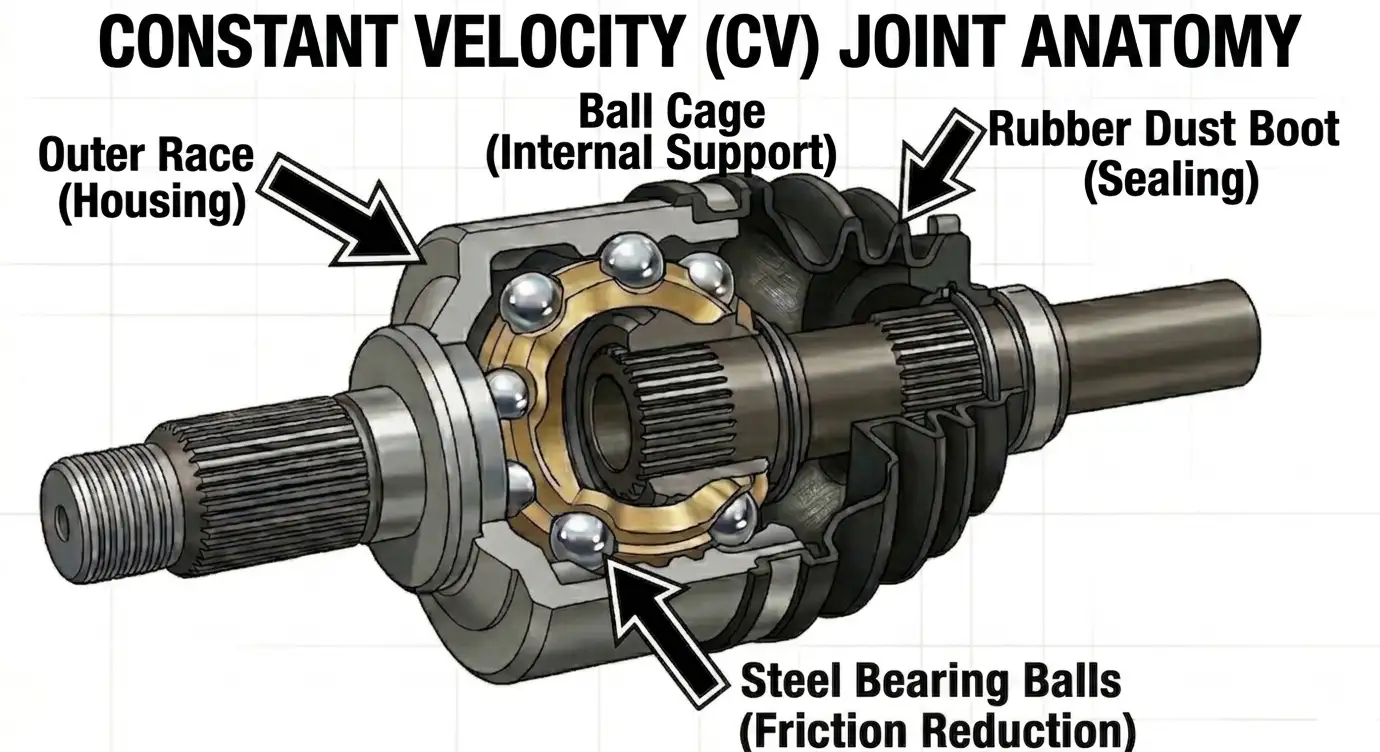
A CV joint (Constant Velocity joint) is a driveline component that transfers power from the transmission to the wheels while allowing the axle to move with suspension travel and steering angles. Its constant velocity design enables smooth power transmission even when the joint operates at varying angles.
A typical CV joint consists of an inner and outer race connected by steel balls held in a cage. This ball-and-groove structure allows the joint to flex smoothly while maintaining consistent power transfer.
The main types of CV joints include:
| Type | Main Feature |
|---|---|
Rzeppa Joint | A ball-type joint designed for high operating angles and smooth power transmission |
Tripod Joint | Provides greater axial movement and is commonly used where plunge capability is needed |
Other Types | Specialized designs for specific performance requirements |
What Is a Universal Joint? What Does It Do?
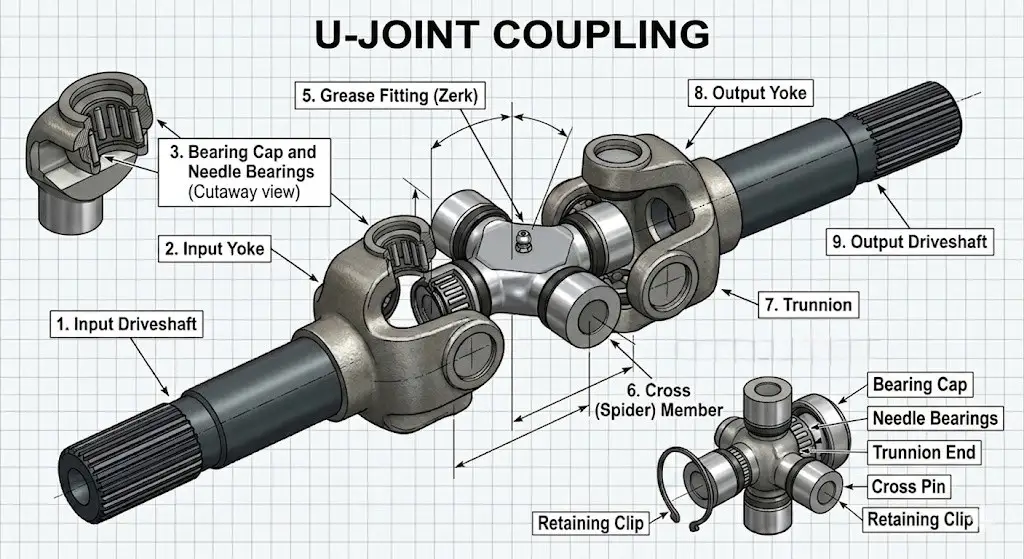
A Universal joint (U-joint) is a driveline component designed to transfer rotational power between shafts operating at an angle. When operating at an angle, a U joint causes slight speed fluctuations during each rotation. These variations can lead to vibration, especially at larger operating angles.
Featuring a cross-shaped design, a U joint uses a central spider connected to four bearing cups that allow the joint to accommodate shaft misalignment while transmitting power.
📚Related Reading:
Universal Joint Types Explained: Comparison & Key Applications
CV Joint vs U Joint: Key Differences
While CV joints and U joints serve similar roles, they differ significantly in design, angle capacity, and maintenance requirements. Here's a quick comparison:
| Comparison | CV Joint | U-Joint |
|---|---|---|
Structure | Ball cage, steel balls, and races (Sealed design) | Cross-shaped spider and bearing caps (Open design) |
Operating Angle | High flexibility (Up to 45–50°) | Limited angle range (Best below 15–25°) |
Torque Capacity | Moderate (Precise) | High (Heavy Duty) |
Vibration & Smoothness | Smooth operation with minimal vibration | More vibration at larger angles |
Maintenance | Low maintenance and usually sealed | Requires regular greasing |
Let's examine these differences in detail.
Design and How They Work
- CV Joint: A sealed assembly built with a ball cage, steel balls, and inner/outer races transfers power while allowing smooth articulation. Packed with specialty grease and protected by a rubber boot, it requires minimal maintenance during operation.
- U Joint: Uses a cross-shaped spider connected to four bearing cups. Unlike a sealed CV joint, most U joints feature a grease fitting (Zerk fitting) that allows regular lubrication to reduce wear.
Angle and Torque Capacity
- CV Joint: Offers a wider operating angle, typically up to 45–50 degrees. This flexibility allows the joint to maintain smooth power transfer during significant changes in axle angle. However, its precision design makes it less suitable for extreme torque loads.
- U Joint: Generally performs best at angles below 15–25 degrees. While larger angles can increase vibration, its simple and robust design provides higher torque capacity for demanding load conditions.
Vibration and Smoothness
- CV Joint: Maintains constant velocity during operation for smoother power delivery and lower vibration. It performs especially well at changing axle angles.
- U Joint: Experiences slight speed variations during rotation when operating at an angle. These fluctuations can create noticeable vibration as the working angle increases.
Maintenance and Lifespan
- CV Joint: Designed for low-maintenance operation, a CV joint mainly depends on the condition of its protective boot for long-term durability. Once the boot is damaged, dirt and moisture can enter the assembly, accelerating wear and increasing the risk of failure.
- U Joint: Requires periodic lubrication to maintain performance. If grease is lost or lubrication is neglected, the bearing surfaces can wear, rust, or seize over time.
CV Joint and U Joint in the Drive System
CV joints and U joints are used in different parts of a vehicle's driveline depending on how power is delivered to the wheels. The layout of the drive system determines where each joint is installed and what type of movement it needs to handle.
Front-Wheel Drive (FWD)
In front-wheel-drive systems, CV joints are commonly used on both ends of the axle shaft. The outer CV joint allows the wheels to steer while maintaining power delivery, while the inner CV joint accommodates suspension movement and changes in axle length.
Rear-Wheel Drive (RWD)
Rear-wheel-drive systems typically use U joints in the driveshaft to transfer power from the transmission to the rear differential. These joints allow the driveshaft and differential input shaft to operate at different angles while transmitting rotational force.
All-Wheel Drive (AWD/4WD)
All-wheel-drive systems may combine CV joints and U joints depending on the drivetrain layout. CV joints are often used where greater angle movement is required, while U joints are commonly used in driveshaft sections that require strong torque transfer.
How to Choose Between CV Joint and U Joint
There are clear factors to consider when deciding between CV joints and U joints. Driving style, vehicle layout, and intended use all determine which option delivers better comfort, durability, and performance. The following guidance serves only as a general reference. You should always combine real vehicle conditions and actual usage scenarios to make your final choice.
- Daily Drivers: CV joints are the standard choice for most modern passenger vehicles. They come standard from the factory to deliver refined ride quality and reliable steering feel.
- Hardcore Off-Roading & Lifted Trucks: U-joints, especially Double Cardan configurations, remain the mainstream choice for main driveshaft setups. For front axles on vehicles such as the Jeep Wrangler, many drivers favour the robust strength of U-joints. Others opt for reinforced CV joints to preserve precise steering feedback on demanding terrain.
- Towing & Commercial Use: U joints are the most practical option here. Their rugged build provides the long-lasting durability needed for heavy hauling day after day. For these demanding applications, you need U joints made from high-strength alloy steel and other wear-resistant materials to handle extreme RPMs or high torque loads. Brands like Zeke Parts design their U joints with these harsh conditions in mind, including high heat, heavy pressure, and lots of dust.
How to Tell If Your CV Joint or U Joint Is Failing
No matter which joint your vehicle uses, failures can occur over time. The following symptoms will help you quickly identify the problem.
CV joint failure symptoms:
- A “click-click-click” noise from outside the vehicle when turning sharply (worn outboard CV joint)
- Vibration under acceleration, especially at medium to high speeds (worn inboard CV joint)
- A torn half-shaft boot with grease leaking out
- A metallic “clunk” from under the vehicle when accelerating or shifting gears
- A rhythmic vibration from the driveline that becomes more intense as speed increases
- Noticeable slack when you rotate the driveshaft by hand (with the vehicle safely raised)
Frequently Asked Questions (FAQ)
How long do CV joints last?
With intact boots, they can often last 100,000 to 150,000 miles. However, if the boot tears, the joint can fail within just a few hundred miles due to road grit.
What is the difference between a CV joint and a CV axle?
A CV joint is the constant velocity joint itself. A CV axle (half-shaft) is the complete assembly, which includes the axle shaft and two CV joints (inboard and outboard). Simply put, the joint is one part of the axle, and the axle is the full unit that transfers power to the wheel. In everyday repairs, both are often replaced together.
Which is better for off-roading, a CV joint or a U-joint?
Light off-roading, such as muddy paths, dirt trails, and mild slopes, works well with a CV joint, which also delivers a smoother ride on regular roads. For rugged rock crawling and extreme off-road conditions, a standard U-joint or double-cardan joint is more reliable. Even so, factory-reinforced CV joints on models like the Land Cruiser 300 are fully capable of handling tough off-road terrain with proper engineering.
Conclusion
There is no perfect joint. Only the right one for a specific application. The CV joint delivers the smooth performance needed for daily city commuters and modern SUVs. The U-joint provides rugged strength suited for work trucks and heavy-duty off-road builds.
No matter what vehicle you own, routine inspections of joint boots and lubrication levels are key to extending service life. If you notice clicking noises or unusual vibrations, check your drivetrain promptly to maintain safe and reliable operation. If you're still feeling unsure about which joint your vehicle needs, just stop by the Zeke Parts website. Our team is here to help and will get back to you within 24 hours.