
Every time a vehicle moves, power must be transferred through drivetrain components that operate under constantly changing angles and loads. Without them, smooth and reliable power transmission would be impossible. One of the key components that makes this possible is the universal joint, or U-joint.
Found in everything from passenger cars to agricultural machinery and industrial conveyor systems, U-joints play a critical role in transmitting torque between misaligned shafts. Yet many people are unfamiliar with the component that keeps these systems operating smoothly. With that in mind, let’s take a closer look at the U-joint.
Table of Contents
What Are Universal Joints
A universal joint in a car is a mechanical device that connects two shafts and allows rotational power to be transmitted even when the shafts are not aligned. In vehicles, it helps accommodate changing driveline angles, reducing binding and wear between the transmission, driveshaft, and rear axle.
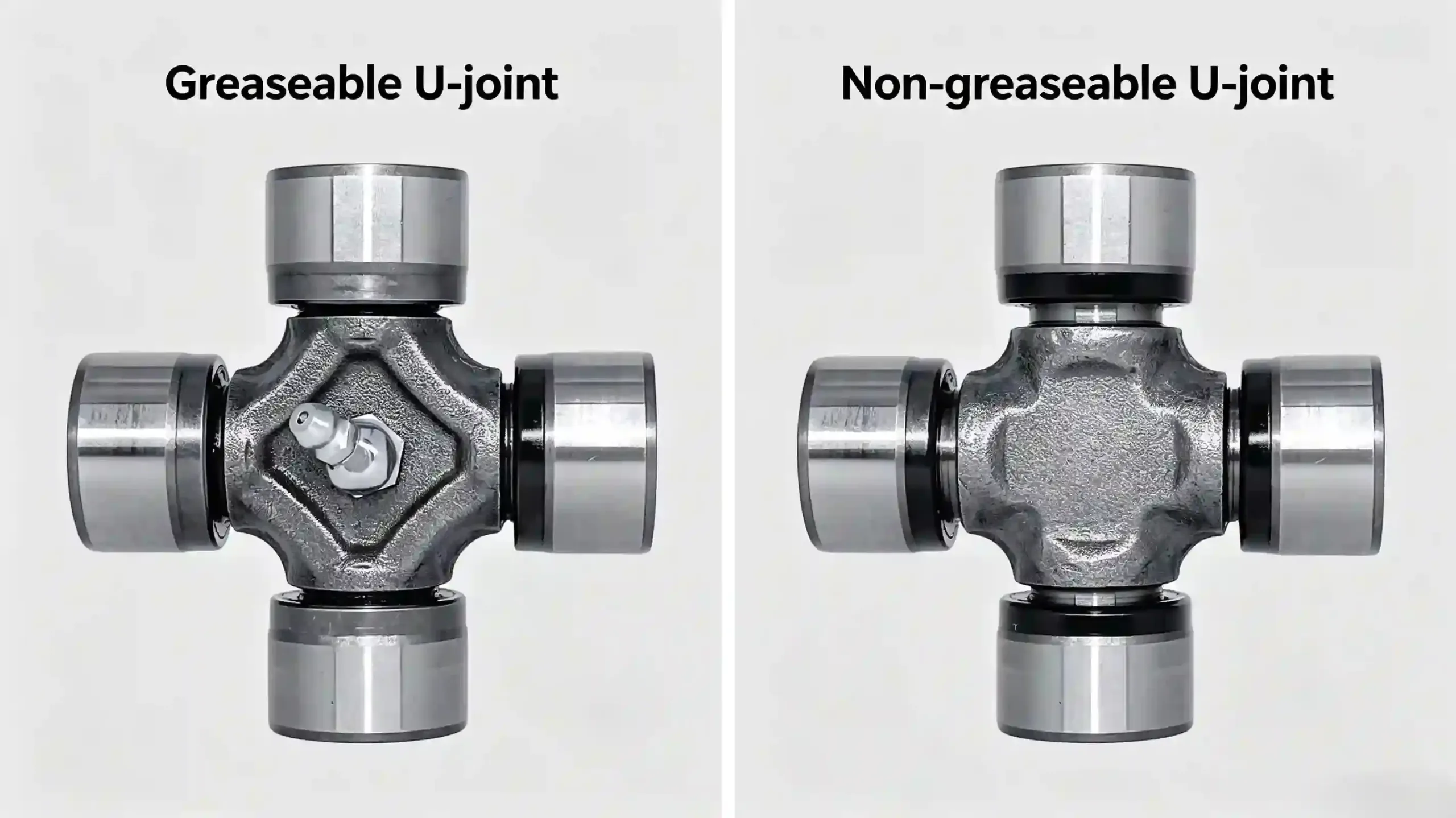
In appearance, the most common type consists of a cross-shaped steel component called a “spider”, with bearing cups mounted on each of its four trunnions. This design allows the joint to articulate in multiple directions while maintaining torque transfer. Some U-joints include grease fittings for periodic lubrication, while sealed versions are designed to be maintenance-free.
Core Components of Universal Joints
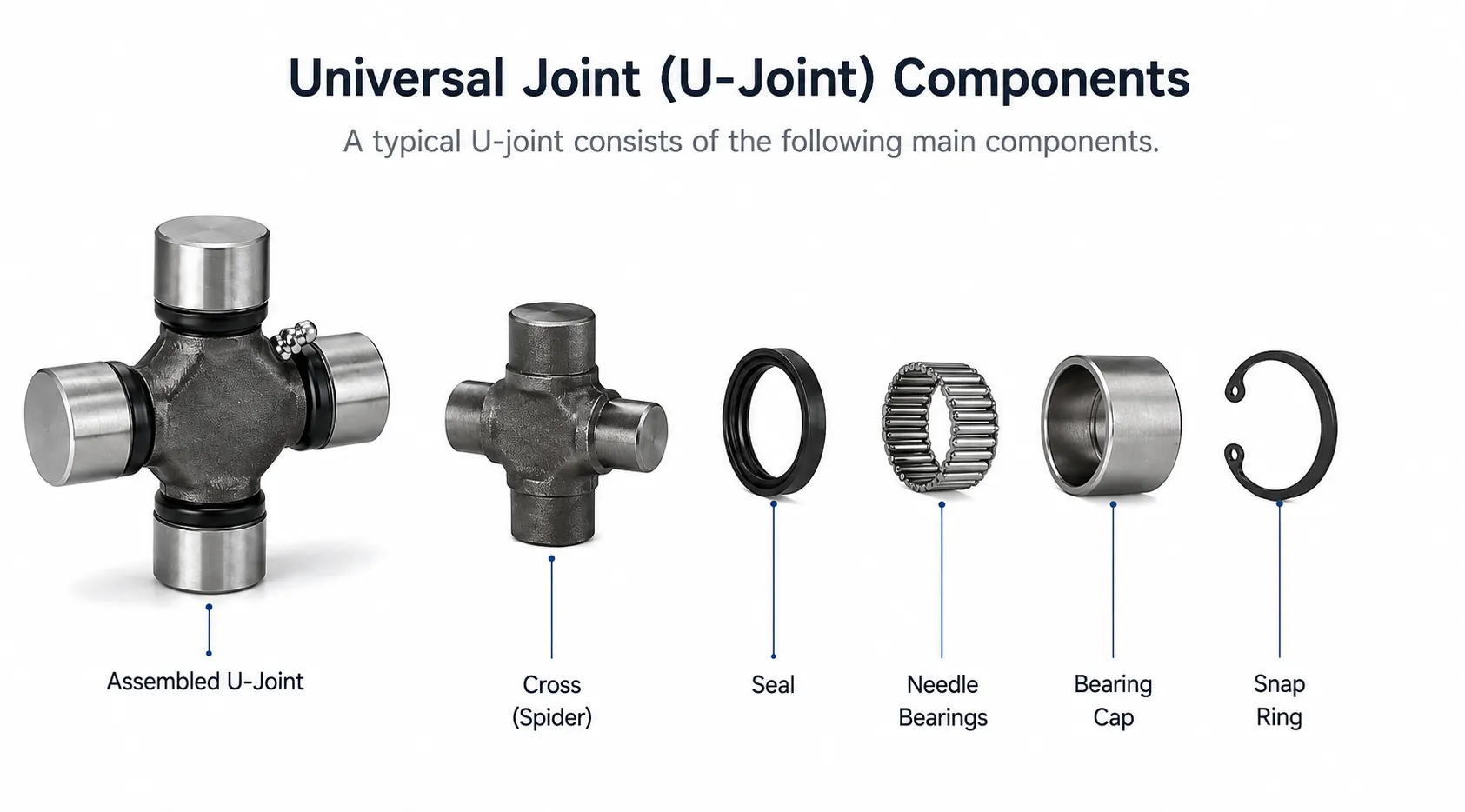
The key components of a standard U-joint include:
- Cross (Spider): The central component of the U-joint. It features four trunnions arranged in a cross shape, each designed to support a bearing cap and transmit torque between connected shafts.
- Bearing Caps: Cup-shaped housings installed on each trunnion of the cross. They contain needle bearings and help support rotational movement under load.
- Needle Bearings: Located inside the bearing caps, these small cylindrical rollers reduce friction between the bearing cap and the trunnion, ensuring smooth operation and long service life.
- Seals: Positioned between the bearing caps and the trunnions, seals retain lubricant and help prevent dirt, moisture, and other contaminants from entering the bearing assembly.
- Retaining Clips (Snap Rings): These clips secure the bearing caps in position within the yoke. Depending on the design, they may be installed internally or externally.
How Do Universal Joints Work
U-joints are typically found on the driveshaft between the transmission and the differential. In rear-wheel-drive vehicles, they allow the driveshaft to flex and accommodate angle changes caused by suspension movement while continuously transmitting rotational power. While most front-wheel-drive cars utilize CV joints to maintain smooth speeds at sharp angles, many four-wheel-drive and all-wheel-drive vehicles rely on multiple U-joints across their front and rear driveshafts or between the transfer case and axles.
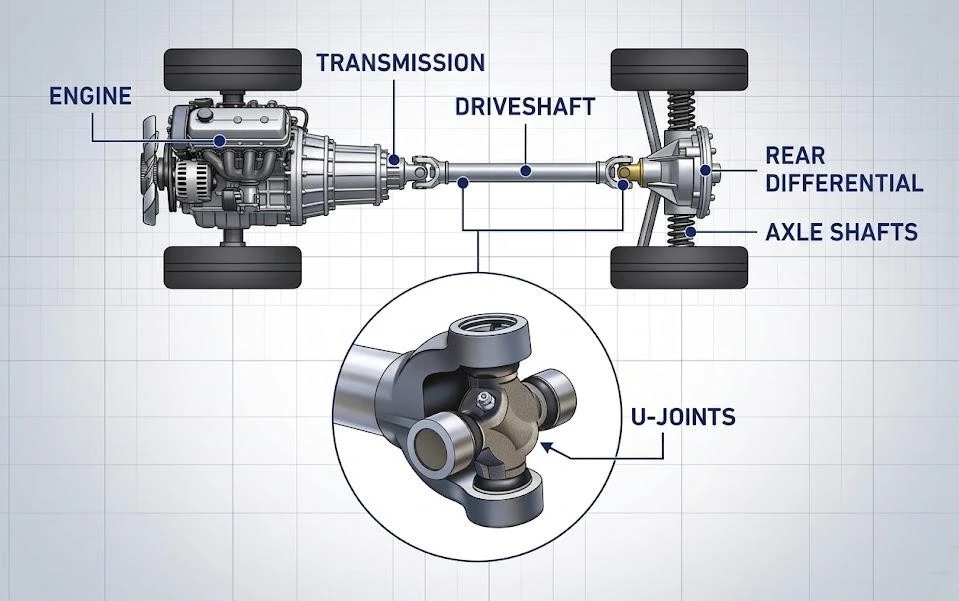
The number of U-joints depends on the drivetrain. A rear-wheel-drive vehicle typically has two U-joints, while longer wheelbase models may add a third with a center support bearing. Four-wheel-drive trucks and SUVs often use four or more U-joints across both driveshafts.
U-Joint Types and Specifications
Universal joints come in different designs and sizes to suit various vehicle applications. The type determines how smoothly power is transmitted, while the series size defines strength and torque capacity. Choosing the right combination is key to reliable drivetrain performance.
Common Types of Universal Joints
Not all U-joints are built the same. Understanding the different U-joint types helps you choose the right replacement for your vehicle and avoid mismatched parts that can lead to premature failure. The most common types include:
- Single U-Joint: The standard configuration with one cross connecting two yokes. It is widely used in driveshaft applications but introduces slight speed fluctuations at steep angles.
- Double Cardan Joint (Double U-Joint): Two single U-joints combined on a single shaft. This design helps cancel out speed fluctuations and provides greater angular flexibility, making it suitable for applications requiring sharper angles.
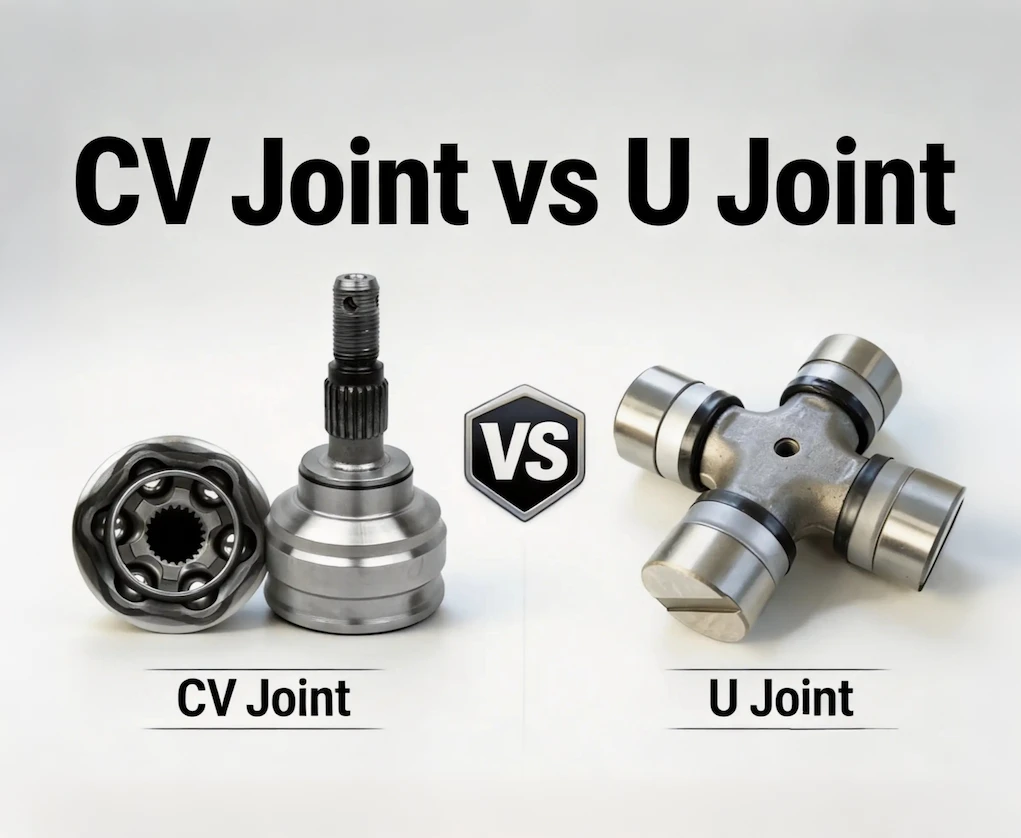
- CV Joint (Constant Velocity Joint): A specialized type of universal joint designed to maintain constant rotational speed regardless of angle. CV joints are commonly found in front-wheel-drive vehicles and are also used in some heavy-duty applications where smooth power delivery is critical.
📚Related Reading: CV Joint vs U Joint: What’s the Difference and How to Choose
Common U-Joint Sizes and Series
Different vehicles and applications require different U-joint series, and these series are used to match specific size and strength requirements. Here are the key series to know.
- 1310 Series (Light-Duty): This is the most common standard size for light-duty applications. It is commonly found in vehicles such as the Jeep Wrangler (TJ and JK models), as well as some Dodge Ram 1500 and Ford F-150 applications.
- 1330 Series (Medium-Duty): Positioned between light-duty and heavy-duty options, the 1330 series is used in driveline applications that require greater strength than the 1310 series. It is often selected for specific trucks and performance vehicles, depending on the drivetrain configuration.
- 1350 Series (Heavy-Duty): Known for its higher torque capacity, the 1350 series is commonly used in heavy-duty and high-performance driveline applications. It is widely used in 1-ton pickup trucks such as the Ford F-350 and other vehicles operating under extreme loads.
Selecting the correct U-joint series is essential for maintaining drivetrain reliability, especially in vehicles subjected to towing, off-roading, or high-performance driving.
What Are U-Joints Used For
When rotational power has to move between shafts that are not perfectly aligned, U-joints make that transfer possible. In vehicles, they help the driveline operate smoothly while allowing for angle changes caused by suspension movement and drivetrain layout.
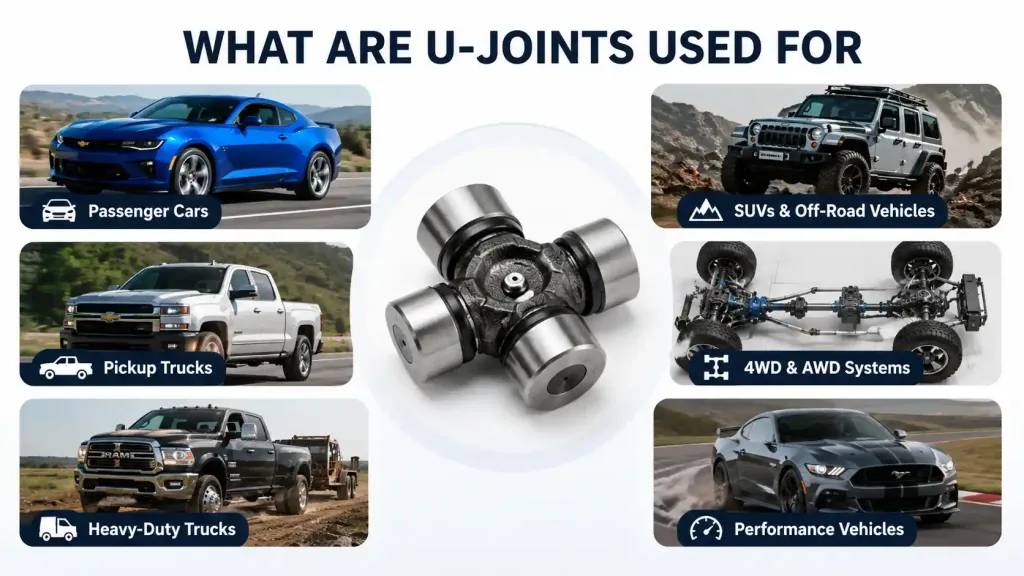
U-joints are used in a wide range of vehicles, but the exact application depends on drivetrain design and operating conditions. Here are some common examples:
- Passenger Cars: Rear-wheel-drive models such as the Chevrolet Camaro use U-joints in the driveshaft to transmit power from the transmission to the rear axle.
- Pickup Trucks: Light-duty trucks, including the Chevrolet Silverado 1500, use U-joints to transfer torque from the transmission to the rear axle.
- Heavy-Duty Trucks: Work-oriented models such as the Ram 3500 rely on heavy-duty U-joints to withstand higher towing and hauling loads.
- SUVs and Off-Road Vehicles: Many SUVs and off-road vehicles use U-joints in their driveline systems to accommodate greater suspension travel and larger operating angles.
- 4WD and AWD Systems: These drivetrains often use a combination of U-joints and CV joints. U-joints are commonly found in driveshafts, while CV joints are typically used on front axle shafts to provide smooth power delivery at larger steering angles.
- Performance Vehicles: High-performance rear-wheel-drive vehicles and modified driveline systems often use upgraded U-joints to handle increased horsepower and torque.
How to Tell If Your U-Joints Are Bad
U-joints can wear out over time, especially on vehicles that carry heavy loads, tow regularly, or see a lot of suspension movement. As a U-joint starts to fail, the symptoms usually begin as small noises or vibrations and gradually worsen. Here are the most common signs of bad U-joints to look for:
- Clunking Noise: A knocking or clunking sound when shifting from Park to Drive or during acceleration.
- Vibration at Speed: Shaking that becomes more noticeable as vehicle speed increases.
- Squeaking Sound: A squeak or chirp, especially at low speeds or when backing up.
- Difficulty Turning: A binding or stiff feeling in the driveline while the vehicle is moving.
- Visible Rust or Looseness: Rust around the bearing caps or noticeable play in the driveshaft or U-joint assembly.
Here’s a quick table to match each bad U-joint symptom with its likely cause and action:
| Symptom | Possible Cause | Recommended Action |
|---|---|---|
Clunking sound | Excess play in the U-joint | Inspect the joint and replace if worn |
Vibration at speed | Worn or failing bearings | Check the driveshaft and U-joint condition |
Squeaking sound | Lack of lubrication or dry bearing caps | Grease the joint or replace it |
Difficulty turning | Joint binding | Replace the U-joint as soon as possible |
Visible rust or looseness | Corrosion or wear | Inspect the joint, yokes, and surrounding hardware |
How Much Does It Cost to Replace a U-Joint
Universal joint replacement cost generally consists of two parts: the replacement U-joint itself and the labor required to install it. According to RepairPal, the average total cost of a U-joint replacement ranges from $337 to $414, although the final price can vary depending on the vehicle model, drivetrain design, location, and any additional repairs that may be required.
U-Joint Parts Cost
For DIY repairs, a replacement U-joint typically costs between $25 and $80 at major auto parts retailers such as AutoZone, with many common applications falling in the $35 to $55 range. However, professional repair shops may charge more for parts due to supplier pricing, OEM components, and shop markups, which can increase the overall repair cost.
Labor Cost
According to RepairPal, labor costs for a typical U-joint replacement are estimated between $156 and $229. Labor requirements can increase on four-wheel-drive vehicles, heavy-duty trucks, or drivetrains with limited access, resulting in a higher total repair bill.
📌 Note: The figures above represent average market estimates. Actual costs may vary depending on your vehicle, the replacement parts used, local labor rates, and any additional repairs required during the service.
Where to Buy High Quality Universal Joints
Finding a reliable source for U-joints is essential for ensuring drivetrain performance and longevity. Buyers have two primary options: local auto parts stores and online platforms.
Local Auto Parts Stores
For those who need a U-joint quickly or prefer in-person assistance, local auto parts stores are a convenient choice. Well-known automotive retailers such as NAPA Auto Parts, AutoZone, and O'Reilly Auto Parts carry a wide selection of U-joints for most common vehicles. By providing your vehicle's year, make, and model, store staff can help identify the correct part. This option is ideal for urgent repairs or when you prefer to inspect the part before purchasing.
Online Platforms
Online shopping offers a broader selection and more competitive pricing compared to local retail. Customers can utilize specialty auto parts stores for detailed technical specifications and compatibility tools, which are essential for ensuring a precise fit for specific vehicle models. Meanwhile, general e-commerce platforms allow for easy comparison across various brands and price points.
Additionally, purchasing directly from OEM or aftermarket car parts manufacturers provides access to premium product lines or custom orders while ensuring the highest level of product authenticity and technical support.
Zeke Parts
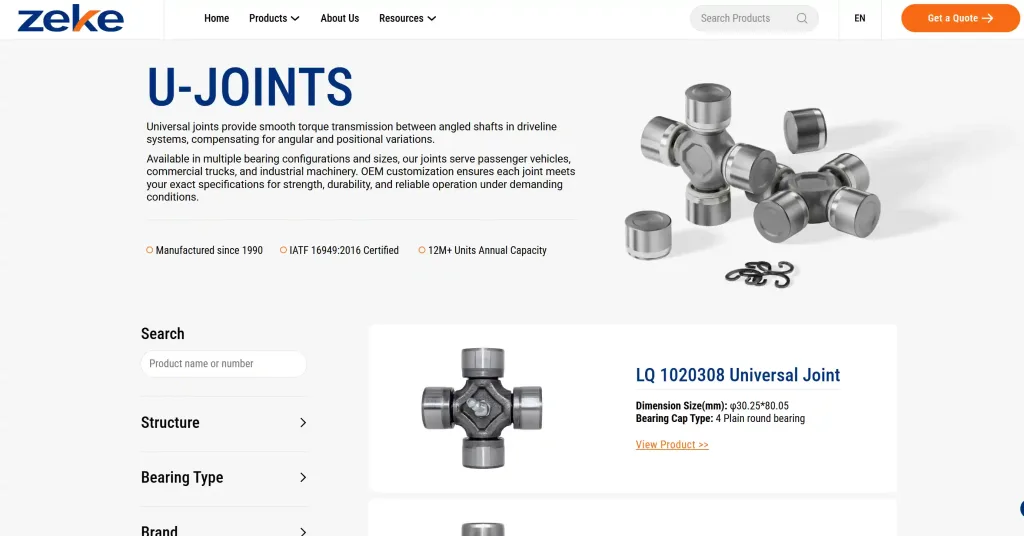
Zeke Parts offers a broad selection of universal joints across multiple series and configurations, supporting both standard replacements and custom orders. The inventory covers a wide range of applications, including passenger cars, heavy-duty trucks, and agricultural equipment.
Single components for personal vehicles and bulk quantities for commercial fleets are both available with competitive pricing. With a focus on quality, variety, and value, Zeke Parts provides a reliable source for universal joint requirements.
Contact UsHow to Maintain Your U-Joints for Maximum Lifespan
Regular maintenance is essential for maximizing U-joint service life and preventing driveline failures. Follow these key practices:
- Grease U-joints at every oil change using NLGI #2 lithium complex EP grease until clean grease extrudes from all four seals. Lubricate more frequently after water submersion or heavy-duty use.
- Inspect U-joints regularly for rust, cracks, excessive play, or damaged seals.
- Keep grease fittings clean and wipe them before applying fresh grease.
- Mark driveline components before disassembly to ensure they are reinstalled in the same position. Clean the mating surfaces and snap ring grooves before installation.
- Replace worn or damaged U-joints promptly with high-quality OEM-grade or equivalent replacement parts.
FAQs about Universal Joints
What are the differences between U-joints and CV joints?
Universal joints are simple, rugged, and cost-effective, making them the better choice for hauling heavy loads or off-road driving. CV joints, on the other hand, are designed to maintain perfectly consistent power delivery, especially during sharp turns, providing a smoother and more vibration-free driving experience.
Where is the U-joint located on a car?
U-joints are located on the driveshaft between the transmission and the differential in rear-wheel-drive and four-wheel-drive vehicles. In four-wheel-drive systems, additional U-joints are found on the front driveshaft as well.
How long can you drive with a bad U-joint?
It depends on the severity of the symptoms. With minor squeaking, a very short trip to a repair shop may be possible. However, if severe vibration or clunking is present, the joint is near failure, and immediate towing is strongly advised to prevent dangerous drivetrain damage.
Final Verdict
Universal joints are small yet vital components that ensure seamless power transmission across your drivetrain. By understanding their function, recognizing early signs of wear, and selecting high-quality parts, you can prevent unexpected breakdowns and avoid costly repairs.
At Zeke Parts, we believe that quality matters whether you are replacing a worn component or sourcing parts for a new build. For a wide selection of reliable U-joints and professional support, we invite you to explore the Zeke Parts website or contact our team to find the perfect solution for your needs.