
Even a million-dollar race car driven by a world champion can be stopped by a common mechanical failure. We saw this happen to the Max Verstappen team at the 2026 Nürburgring 24 Hours. They were to win, but a sudden drive shaft failure ended their championship hopes.
This single part is responsible for getting power from your engine to the wheels. Without a drive shaft, your car simply cannot move. Understanding how a drive shaft works is key to avoiding costly repairs and dangerous breakdowns. In this guide, we will break down everything you need to know about this critical drivetrain part.
Table of Contents
What Is a Drive Shaft in a Car
A drive shaft is a rotating mechanical component that transmits power and torque from the transmission to the differential, enabling engine energy to reach the wheels. It serves as a critical connection between drivetrain parts that are separated by distance and must remain independent to allow for vehicle movement.
Key Components of a Drive Shaft
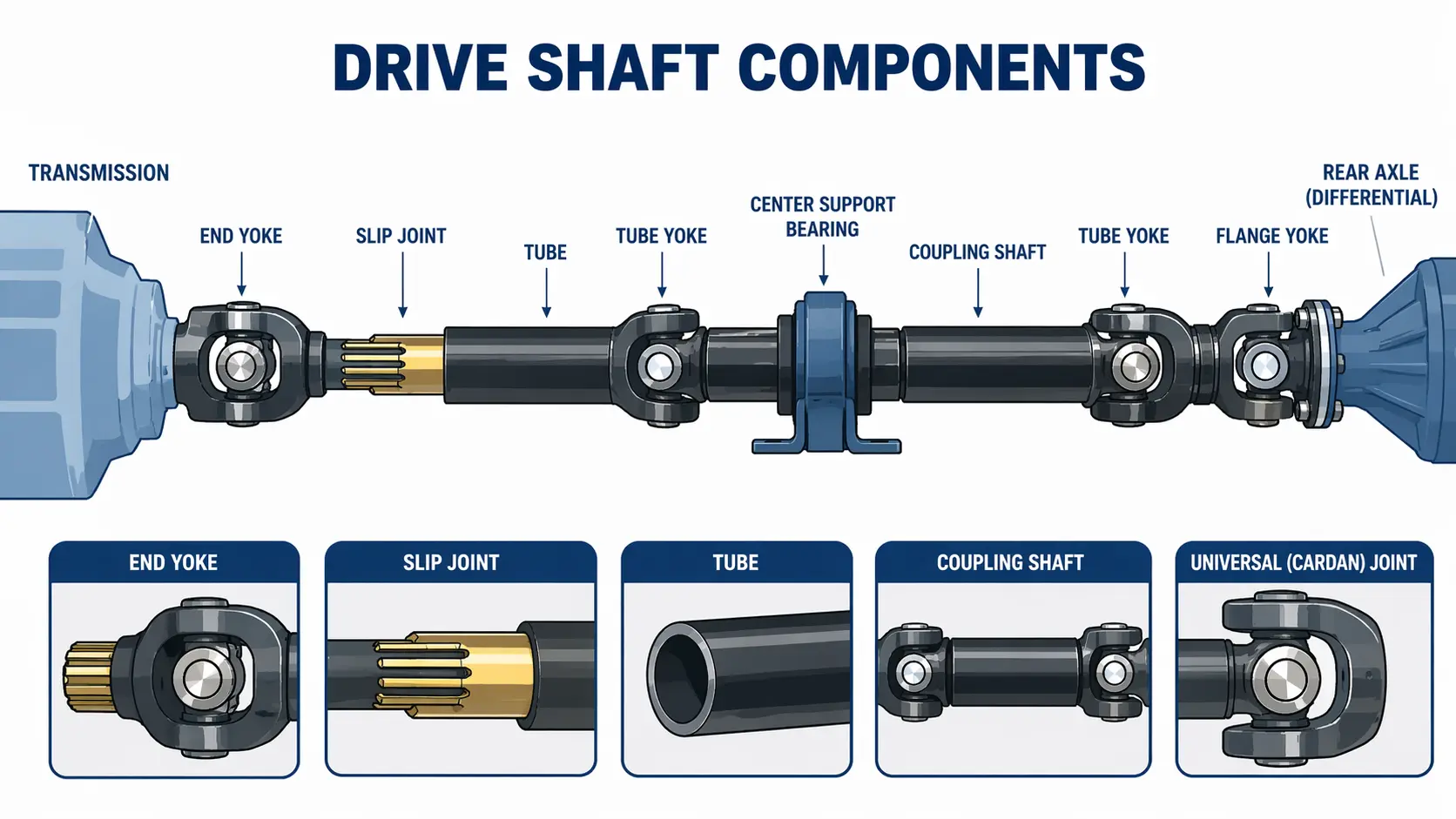
Modern drive shafts, particularly those in heavy-duty trucks, are sophisticated assemblies designed to handle high-speed rotation while maintaining perfect balance. The primary components include:
- Tube: The main cylindrical body of the shaft. It is typically hollow to reduce weight and is made of steel (preferred for a heavy-duty truck drive shaft due to strength), aluminum, or even carbon fiber.
- Yokes: These are critical connectors. There are three main types: tube yokes (welded into the tube), end yokes (which fit over transmission or axle splined shafts), and flange yokes (which hold U-joint bearing caps and bolt directly to other drivetrain parts).
- Slip Joint: A two-piece splined assembly that allows the drive shaft to lengthen or shorten. This flexibility is essential to accommodate changes in distance caused by suspension movement, braking, and acceleration.
- Coupling Shaft: In multi-shaft systems (common in long vehicles), this is a short shaft section without a slip joint that requires a center support bearing.
- Universal Joint (U-joint): Often called a U-joint, this pivot allows the shaft to operate at various angles. It ensures power flow remains uninterrupted even as the transmission and axle move out of alignment.
Drive Shaft Location in a Vehicle
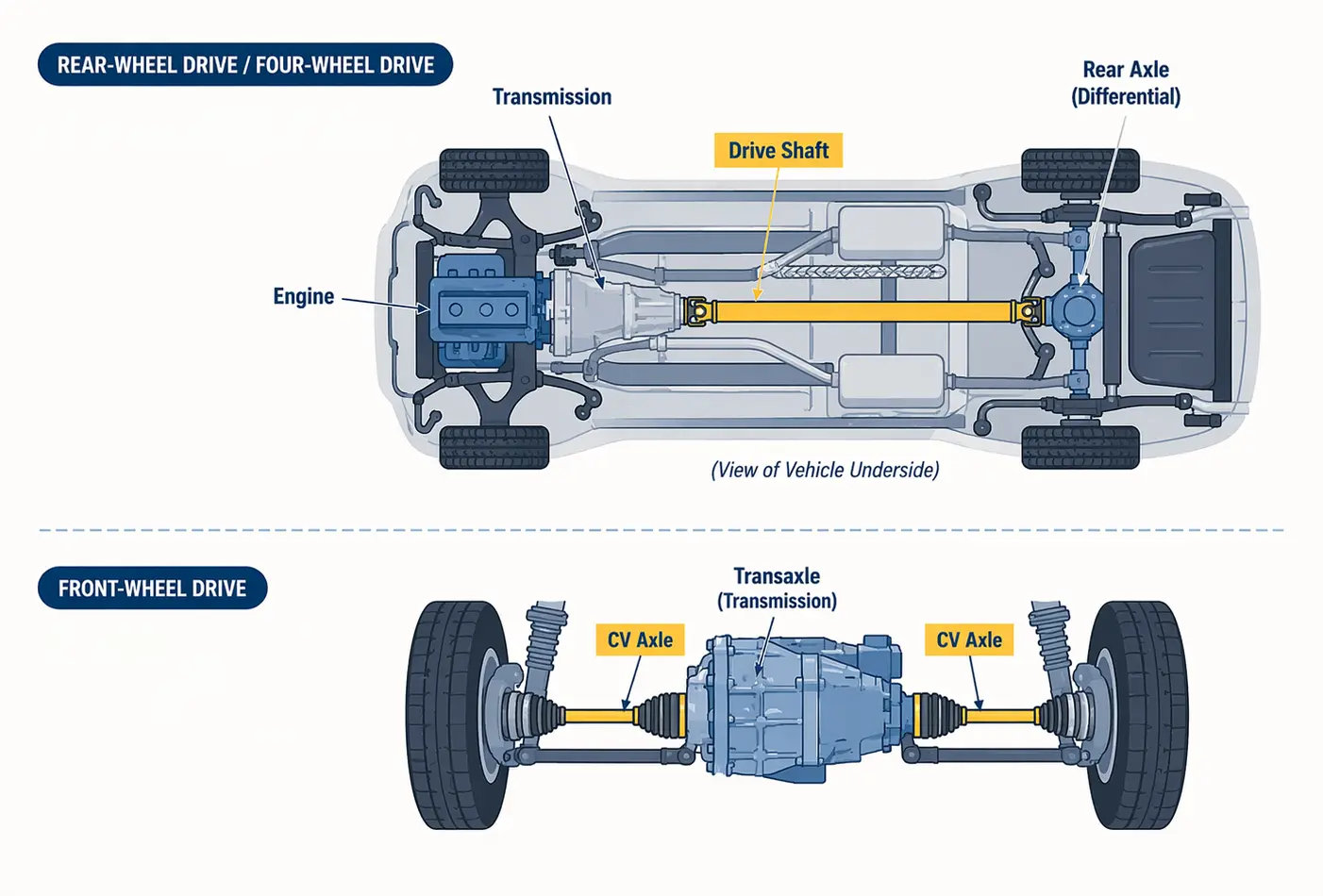
Locating the drive shaft is relatively simple if you can look underneath the vehicle. It is typically situated along the chassis centerline.
In rear-wheel drive or four-wheel drive vehicles, you can clearly observe a long metal tube extending longitudinally through the center of the underbody. It bridges the gap between the transmission (located at the back of the engine) and the rear axle. In many cars, the drive shaft is partially hidden by the exhaust system or heat shields to protect it from road debris and extreme temperatures.
For front-wheel drive cars, the "drive shafts" are much shorter and located between the transaxle and the wheel hubs. These are usually referred to as CV (Constant Velocity) axles, but they perform the same fundamental job of power transmission.
How Does a Drive Shaft Work
A drive shaft works by carrying rotational power from the transmission to the differential. To function effectively, it must accommodate constant changes in angle and distance between the transmission and axle, which occur as the suspension moves over bumps or during acceleration and braking.
It achieves this through two key mechanisms. Universal joints allow the shaft to operate at varying angles without binding. A slip joint enables the shaft to lengthen or shorten as the suspension compresses and extends. These components work together to deliver power smoothly while adapting to the vehicle's constantly changing geometry.
Different Types of Drive Shafts
Drive shaft designs vary significantly based on the vehicle's drivetrain layout and intended use. Choosing the right design is a balance between weight, cost, and power requirements.
| Type | Description | Common Application |
|---|---|---|
Rear-Wheel Drive (RWD) Shaft | A long, longitudinal shaft connecting the front transmission to the rear differential. | Sedans, Sports Cars, SUVs, including Ford Mustang, Chevy Camaro, Dodge Charger |
Four-Wheel Drive (4WD/AWD) Shaft | Usually consists of two shafts (front and rear) connected via a transfer case. | Off-road vehicles, AWD Crossovers, including Jeep Wrangler, Ford Bronco, Chevy Silverado, Dodge Ram |
Front-Wheel Drive (FWD) Shaft | Often called "half-shafts," these transfer power from a transverse gearbox to the front wheels. | Most modern compact cars, including Ford Focus, Chevy Malibu, Dodge Dart |
Commercial Vehicle Shaft | Multi-piece designs featuring intermediate bearings to handle extreme lengths and loads. | Heavy-duty trucks, buses, including Ford F-650, Chevy Kodiak, Dodge Ram 5500, Jeep Gladiator |
In 4WD vehicles, the front drive shaft is often shorter and must handle more extreme angles because the front wheels also perform steering duties. In contrast, RWD shafts are built for high-speed cruising and long-distance durability. Selecting the correct drive shaft assembly is essential to ensure maximum torque transfer and component longevity across these different drivetrain configurations.
Drive Shaft vs Axle Shaft
Drive shaft and axle shaft are both key components in a vehicle's drivetrain, and their similar names often confuse. Many people use the terms interchangeably, but they actually serve very different roles in power transmission.
To better understand their differences in function, structure, and working position, the comparison below provides a clear overview.
| Aspect | Drive Shaft | Axle Shaft |
|---|---|---|
Primary Function | Transmits power from the transmission/transfer case to the drive axle (differential) | Transmits power from the differential to the drive wheels |
Location | Located underneath the vehicle, longitudinally (front to rear) | Located inside the axle housing, laterally (from differential outward to each wheel) |
Vehicle Type | Found in front-engine rear-wheel drive (FR) and 4WD/AWD vehicles | Found on all drive wheels (FWD, RWD, 4WD/AWD) |
Typical Structure | Typically a single long shaft (may be two-piece with a center bearing), with U-joints at each end | Typically two short shafts (left and right), with constant velocity (CV) joints at both ends |
What Are the Symptoms of a Bad Drive Shaft
A drive shaft typically lasts about 120,000 km (75,000 miles), but wear from regular use can shorten its lifespan. Catching problems early can save you from expensive drivetrain repairs.
Watch for these warning signs of a failing drive shaft:
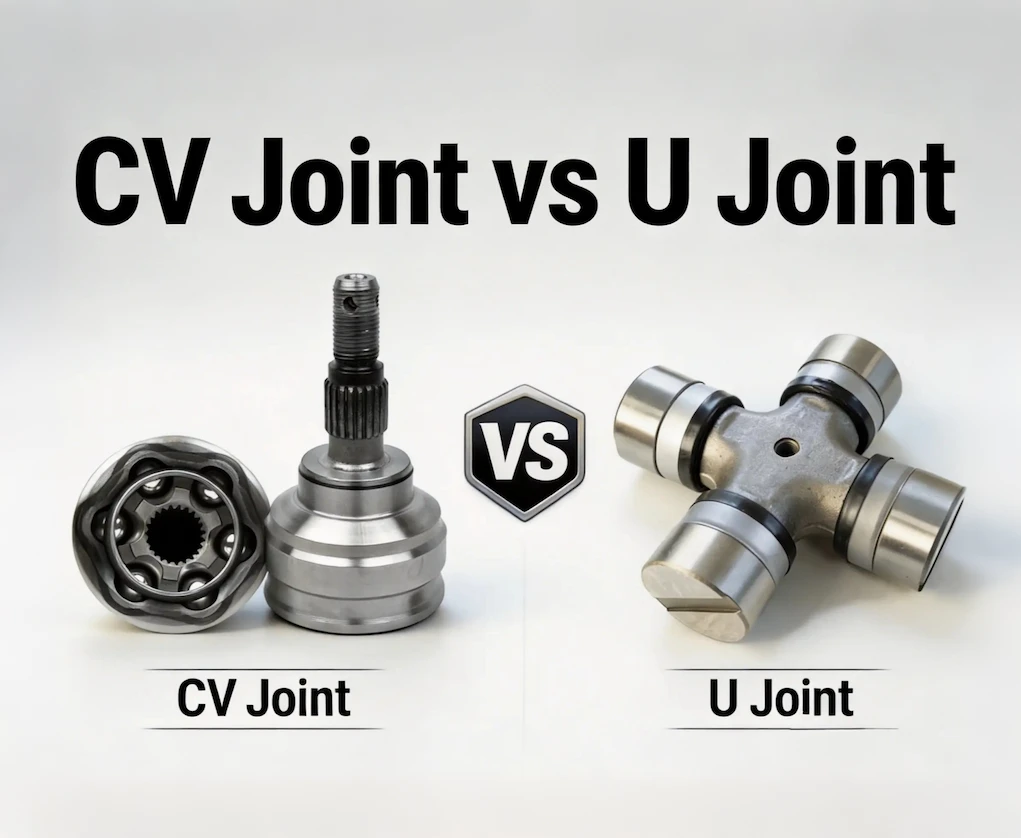
- Unusual noises from underneath the vehicle. You may hear clicking, squeaking, or grinding sounds while driving. These noises often point to worn universal joints or CV joints.
- Clunking when shifting or turning. Loud clunks during acceleration, reversing, or cornering suggest excessive play or looseness in the shaft’s connecting parts.
- Noticeable vibrations. A strong shaking felt through the floorboard, especially when speeding up, is one of the most common early indicators. Worn bearings or unbalanced joints are usually the cause.
- Difficulty steering. The vehicle may feel less responsive or harder to turn, both at low speeds and on the highway.
If you experience any of these symptoms, do not ignore them. Have a professional inspect your drive shaft promptly. Replacing a failing shaft early is far more affordable than repairing the transmission, differential, or other components that can be damaged if the shaft fails.
How Much Does Drive Shaft Replacement Cost?
The cost to fix a drive shaft typically ranges from $400 to over $1500, depending on your vehicle type, parts choice, and local labor rates. The table below breaks down the main cost components.
| Category | Price Range | Explanation |
|---|---|---|
Total Replacement Cost (Parts + Labor) | $400–$1,500+ | Standard: $400–$1,200 (RWD/FWD, simpler systems); AWD/trucks/luxury: $1,200–$2,000+ (more complex drivetrains and higher labor). |
Aftermarket Drive Shaft | $300–$800 | Standard replacement option for most vehicles, offering good value. |
OEM Drive Shaft | $800–$1,800+ | Higher cost reflects OEM design standards, warranty, and dealer pricing. |
Labor Cost | $150–$500 | Varies based on vehicle layout and installation complexity. |
U-Joint Replacement | $300–$450 | Based on RepairPal average estimates. |
Center Support Bearing Replacement | $200–$500 | Required for vehicles with two-piece driveshaft systems. |
The prices above are estimates for reference only. Actual costs vary by location, shop, and vehicle model. For example, while a standard replacement may fit most budgets, performance-oriented upgrades like an aluminum drive shaft for a 2016 Dodge Challenger can deliver noticeable gains in drivetrain response, but such modifications come at a higher price.
For a durable and cost-effective alternative, Zeke Parts supplies high-strength alloy steel drive shafts with anti-corrosion coatings, suitable for heavy-duty industrial applications. Complete assemblies and custom services are available, with small batch trial orders welcome. For more information or a quote, feel free to get in touch.
Contact UsFAQs About Drive Shafts
What is a drive shaft bearing?
A drive shaft bearing, also known as a center support bearing, is used to support longer drive shafts. It is typically encased in a rubber ring and bolted to the vehicle's frame, helping to reduce shaft wobble and absorb operational noise.
What happens when a drive shaft fails?
If a drive shaft fails while driving, the vehicle may lose power to the wheels, leaving it unable to move. In severe cases, the shaft can detach or break apart, potentially causing extensive damage to the transmission, differential, exhaust system, or fuel lines, and posing a serious safety risk.
What is the difference between a drive shaft and a cardan shaft?
The difference lies in terminology. A drive shaft is a broad term for any rotating shaft that transmits power. A cardan shaft specifically refers to a drive shaft that uses a universal joint structure. In the automotive world, most rear-wheel drive shafts are technically cardan shafts, which is why mechanics often use the two terms interchangeably.
Conclusion
The drive shaft is a vital link in your vehicle's power chain. From facilitating smooth power transfer to accommodating the constant movement of your suspension, its role is indispensable. By staying alert to vibrations and noises, and choosing quality replacements when necessary, you can ensure your vehicle remains reliable for years to come. Regular inspections and timely maintenance are the keys to a healthy, long-lasting drivetrain.