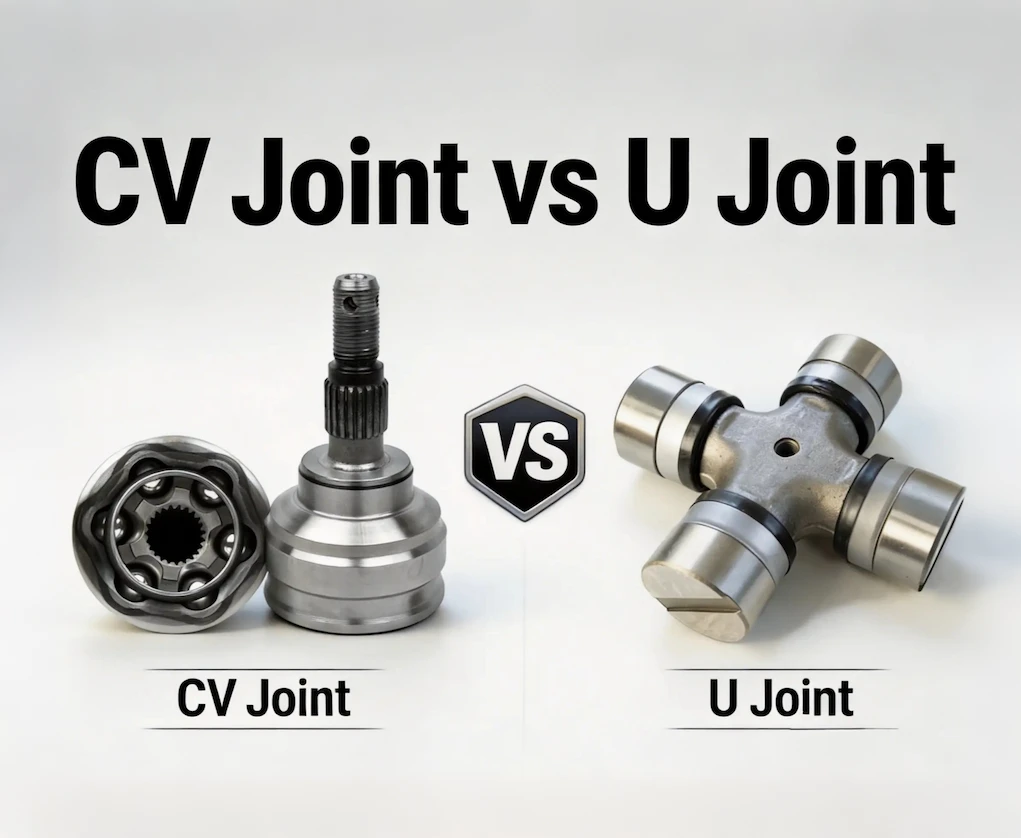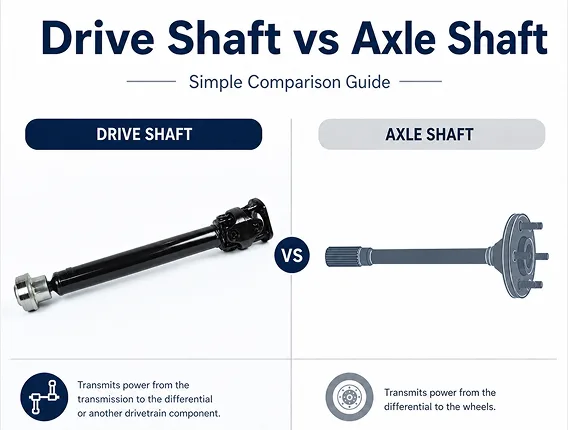

The driveshaft yoke is an easily overlooked but critically important component. Located at the ends of the driveshaft, it holds the universal joint, transmits torque, and compensates for angle changes. Many people instinctively replace the U-joint or the entire driveshaft when they experience driveline issues. After going in circles, they find the problem remains, and the root cause is actually yoke wear or distortion.
There are several types of yokes, including slip, tube, flange, and pinion, each with a different structure. Buy the wrong one and it will not fit, or worse, it will not last. This guide covers yoke identification, function, failure symptoms, and selection so you can spot damage and choose the right replacement.
📢Disclaimer: Dimensions, torque specifications, spline parameters, and other data mentioned in this article are general industry references only. Actual specifications vary by brand, material, vehicle configuration, and region. Perform all repairs and modifications at your own risk and consult a professional whenever possible.
Table of Contents
What Is a Driveshaft Yoke?
A driveshaft yoke is a U-shaped metal connector installed at the end of a driveshaft or on a mating driveline component. The two yoke ears hold the U-joint bearing caps, while the center bore or spline opening connects to the driveshaft tube or output shaft.
Yokes are commonly installed in three locations:
- Transmission or transfer case output (slip yoke)
- Ends of the driveshaft tube (tube yoke or weld yoke)
- Differential pinion input (pinion yoke or end yoke)
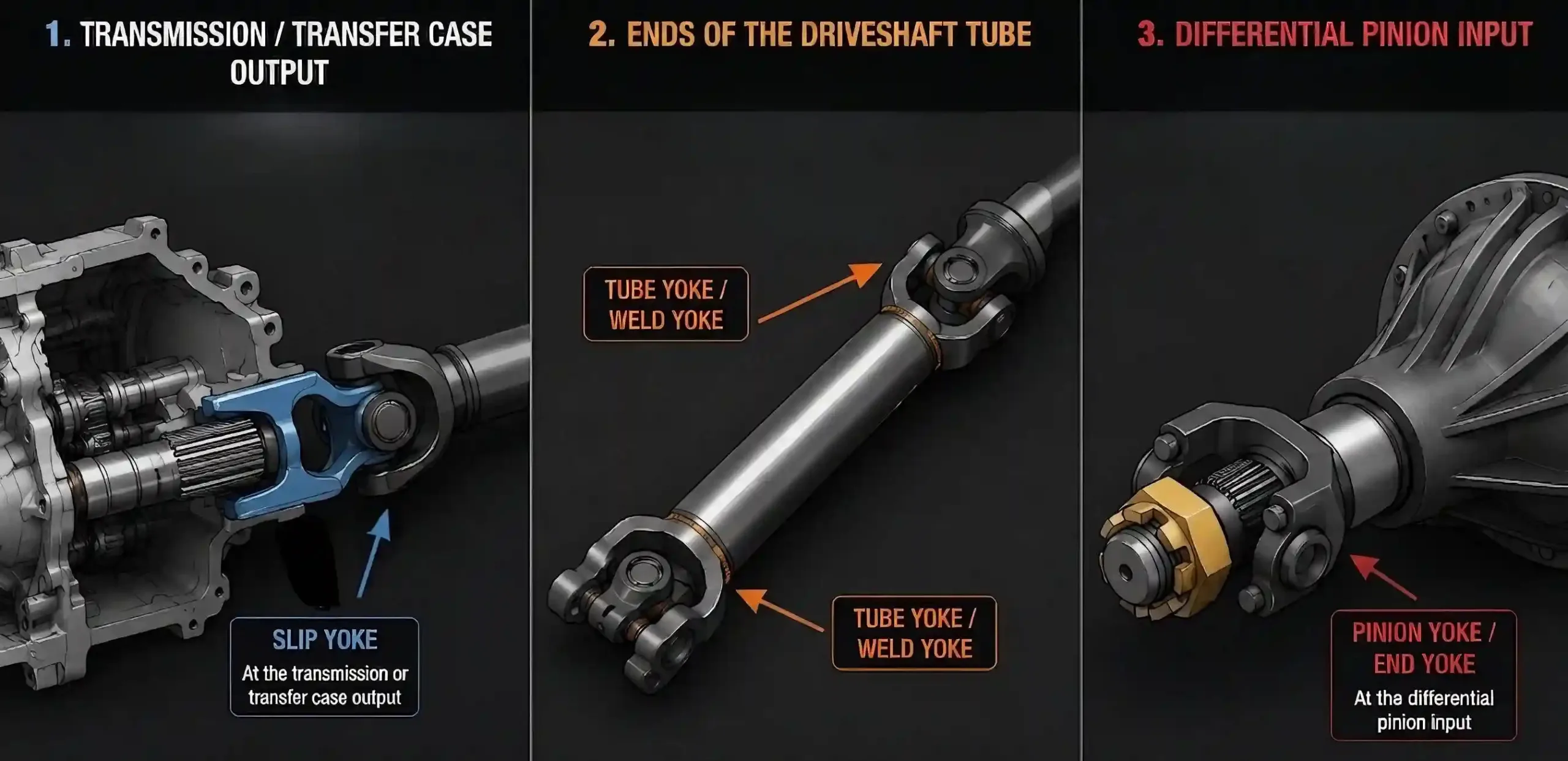
The yoke can be understood as the final connection point in the driveline power path. Without it, the U-joint cannot be mounted, and torque cannot continue through the drivetrain.
What Does a Driveshaft Yoke Do?
A driveshaft yoke performs three primary functions in the driveline system.
- Transfers torque: Delivers rotational power between the driveshaft and transmission, transfer case, or differential. Yoke failure will cut off power delivery and disable vehicle movement.
- Secures the U-joint: Serves as mounting support to keep the U-joint fixed while enabling pivoting. Worn or deformed yoke ears may lead to a loose or detached universal joint and even cause the drive shaft to fall off.
- Compensates for angle and length variations: Fixed yokes realize angular displacement via U-joints. Slip yokes support rotation and axial sliding, adapting to length changes caused by suspension travel.
A failing yoke usually does not destroy the vehicle immediately. Instead, it gradually damages surrounding driveline components over time. By the time severe vibration or metallic knocking becomes noticeable, the transfer case or differential may already have suffered expensive damage.
Common Types of Driveshaft Yokes
The most common driveshaft yokes can generally be divided into four types based on their function and connection method.
| Yoke Type | Main Function | Common Location | Key Feature |
|---|---|---|---|
Slip Yoke | Allows length movement | Transmission/transfer case output | Sliding spline design |
Weld Yoke/Tube Yoke | Connects driveshaft tube to U-joint | Driveshaft ends | Welded permanently |
Flange Yoke | Bolted driveline connection | Heavy-duty applications | Flange and bolt design |
Pinion Yoke/End Yoke | Connects driveshaft to differential | Differential input | Mounted on pinion shaft |
Type 1: Slip Yokes
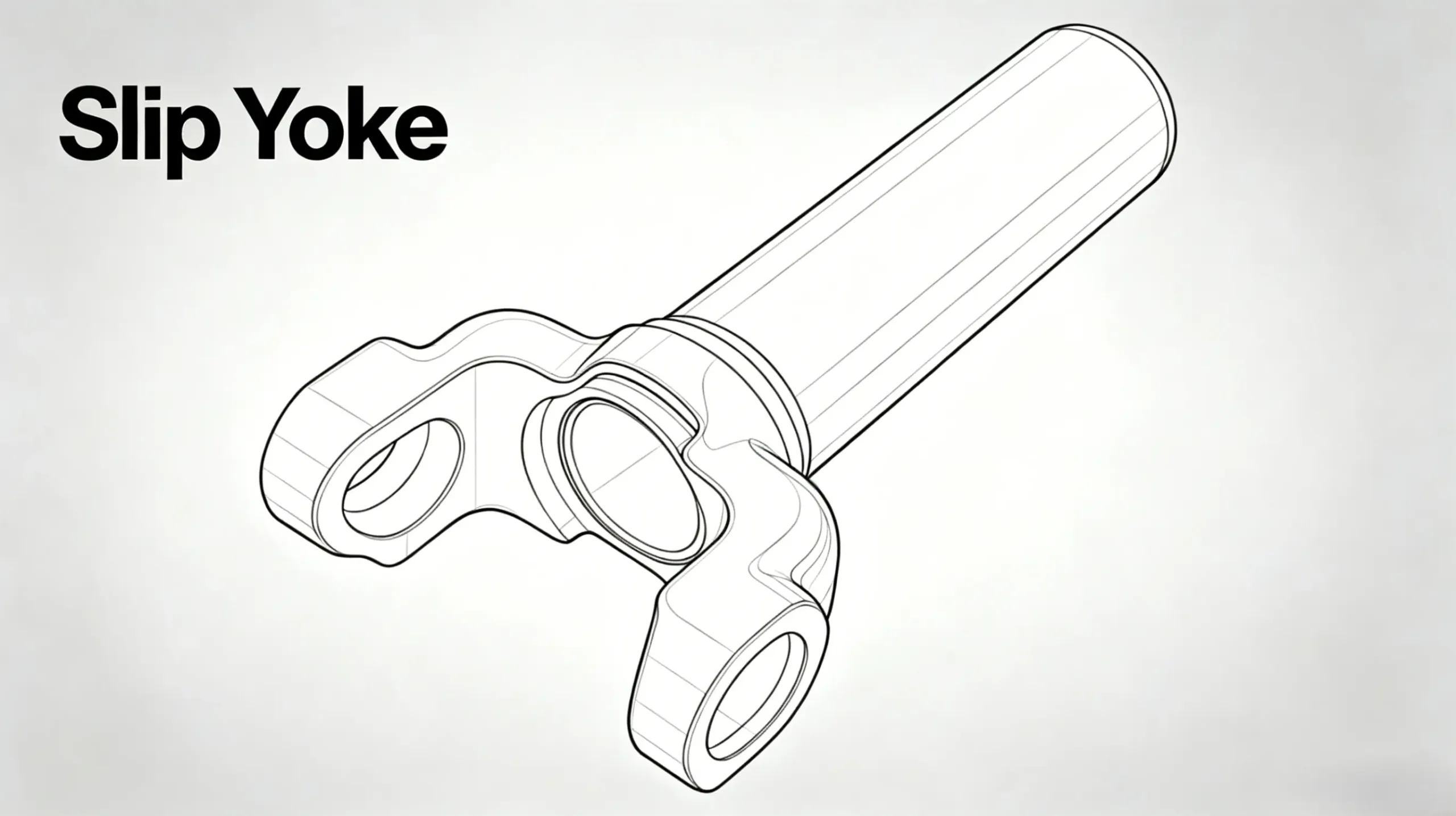
A slip yoke contains internal splines, a smooth sealing surface, and two yoke ears at the end. While rotating with the driveshaft, it can also slide forward and backward inside the transmission or transfer case output housing. The splines engage with the output shaft while still allowing axial movement, enabling the driveshaft to compensate for suspension travel.
Slip yokes are commonly found at the output of rear-wheel-drive transmissions and four-wheel-drive transfer cases. Since drivetrain configurations vary, slip yokes are available in different spline specifications. For replacement needs, Zeke Parts offers various spline options to meet different drivetrain requirements. If you're unsure which one fits your specific application, feel free to contact us for expert assistance.
Advantages: A slip yoke has a compact structure that transmits rotary power and allows axial expansion at the same time, effectively preventing rigid interference between the driveshaft and surrounding components.
Disadvantages: Long-term sliding wears down the splines, and too much clearance causes abnormal noise. Worn sealing surfaces leak oil, and the yoke needs regular lubrication.
💡Slip Yoke vs. Fixed Yoke
A slip yoke slides to take up length changes from suspension travel; a fixed yoke bolts in place and doesn’t move. Of the four types here, weld, flange, and pinion yokes are all fixed, so the driveshaft needs its own slip joint elsewhere to compensate.
Type 2: Weld Yokes/Tube Yokes
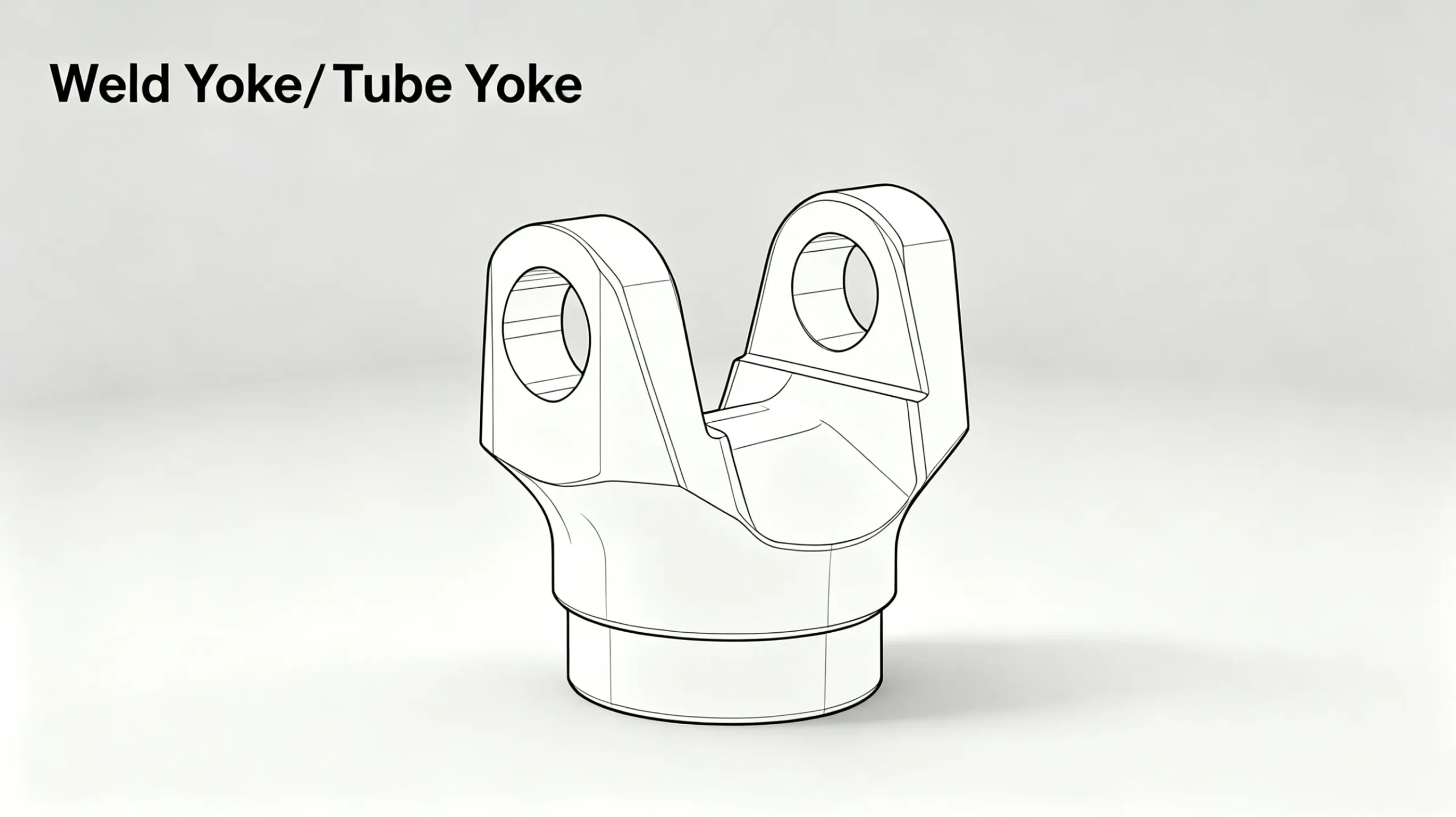
"Weld yoke" and "tube yoke" refer to the same component. The term "weld yoke" describes the manufacturing method, while "tube yoke" describes its installation position. Most OEM driveshafts use this design at both ends.
A weld yoke has a cylindrical tube section on one side and two U-joint mounting ears on the other. The tube section slips over the driveshaft tube and is permanently welded into place. Its purpose is to provide a strong mounting point for the U-joint while maintaining structural strength and balance.
Advantages: The weld yoke connects firmly, costs little to produce, supports mass production, and handles high torque loads.
Disadvantages: It requires strict welding precision. Misaligned welding impairs the driveshaft's dynamic balance. Because it forms a permanent joint, replacement requires cutting and rewelding.
Type 3: Flange Yokes
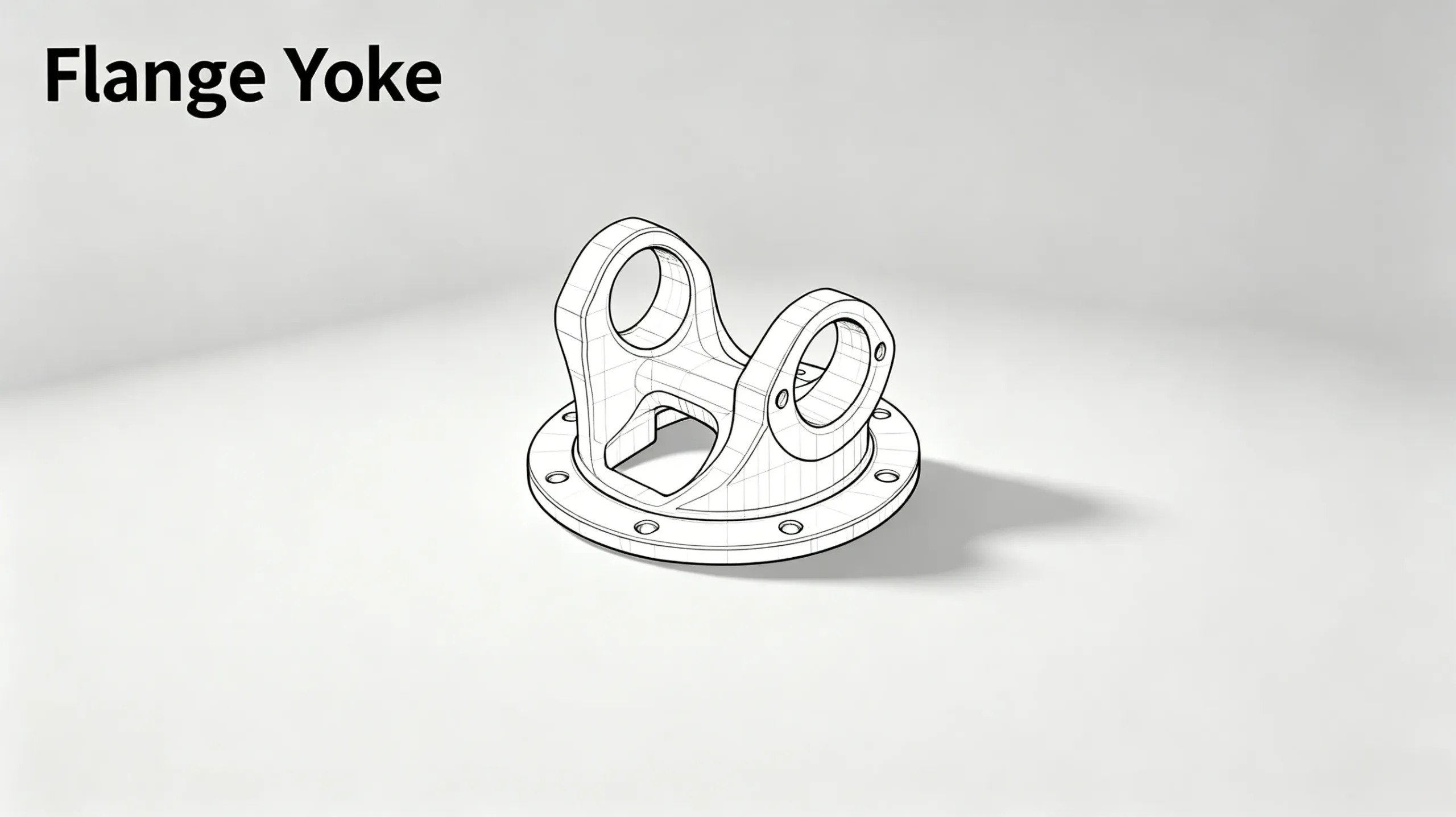
A flange yoke has a flat, bolted flange at one end, while the opposite end still contains the U-joint mounting ears. This design improves alignment precision, torque capacity, and connection reliability. Flange yokes are commonly used on heavy-duty trucks, some European vehicles, and high-performance driveline systems.
Advantages: The flange yoke delivers excellent alignment accuracy, offers high torque capacity, provides a reliable bolt-on connection, and allows easy installation and removal.
Disadvantages: It has a higher manufacturing cost, requires strict flange compatibility, and offers limited interchangeability between specifications.
Type 4: End Yokes/Pinion Yokes
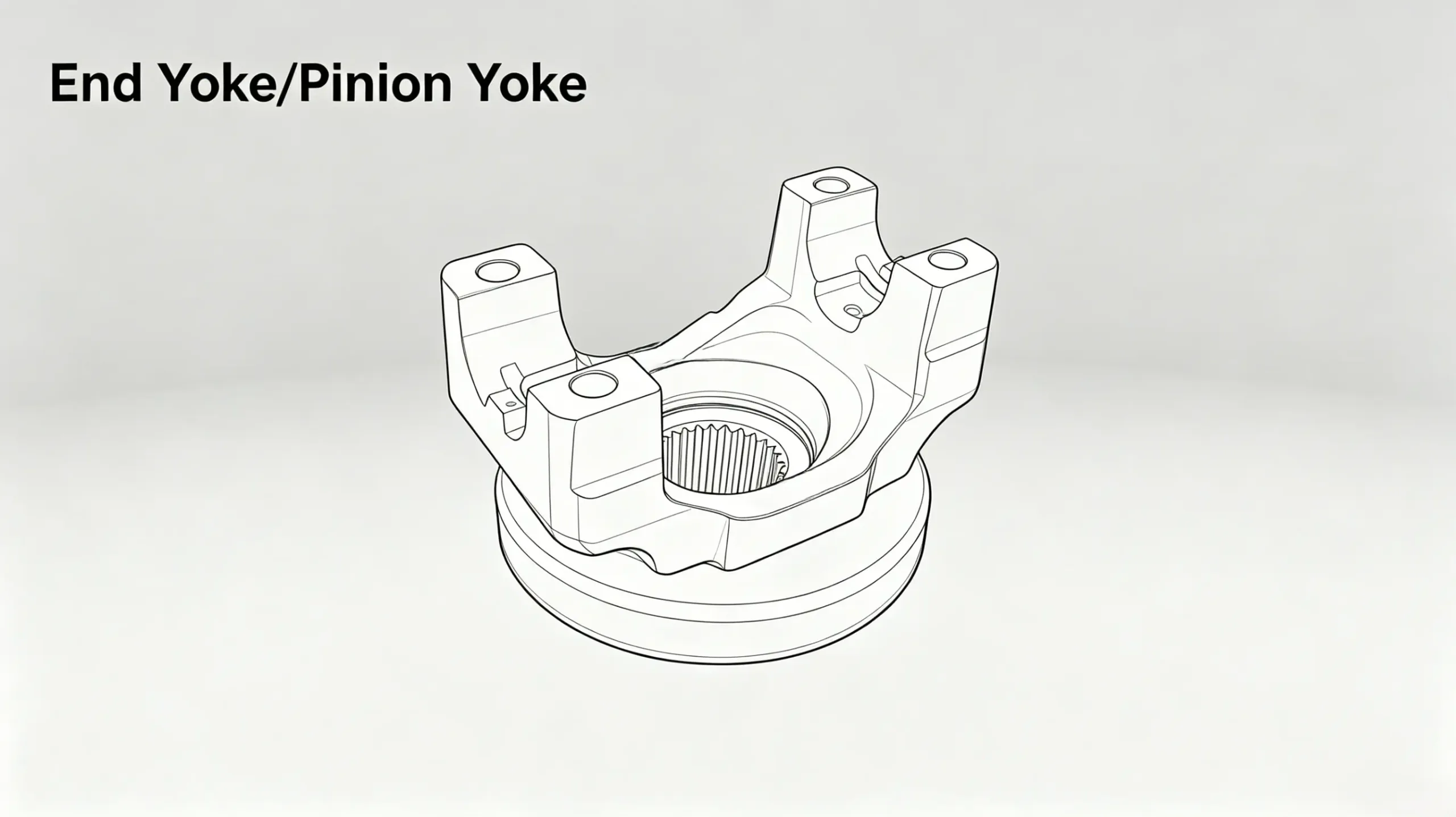
Technically, all pinion yokes are end yokes, but not all end yokes are pinion yokes. In everyday conversation, the terms are often used interchangeably, though “pinion yoke” is more accurate for parts ordering.
A pinion yoke contains a splined center bore that fits onto the differential pinion shaft. The outer section contains the U-joint mounting ears, and the entire yoke is secured using a large retaining nut. Unlike a slip yoke, it does not move axially. This yoke is installed at the differential input and transfers power directly into the differential assembly.
Advantages: The pinion yoke connects directly to the differential, provides a short power path, features a simple structure, and offers high load capacity.
Disadvantages: It requires precise pinion nut torque, as improper preload can damage bearings. Removal often requires special tools, and spline variations make selection easy to mistake.
Symptoms of a Failing Driveshaft Yoke
A failing yoke usually creates progressive driveline problems rather than an immediate breakdown. Recognizing early symptoms can save you from costly repairs, including a full driveshaft replacement or transfer case damage. Below are the key signs of yoke failure.
Early Warning Signs:
- Metallic clunking during acceleration or shifting is usually caused by worn bearing seats or bent yoke ears.
- Persistent vibration that increases with vehicle speed, often caused by bent yokes or driveline imbalance.
- Fluid leakage near a slip yoke, typically caused by worn sealing surfaces or excessive spline movement, damages the driveshaft yoke oil seal.
Visual Inspection Signs:
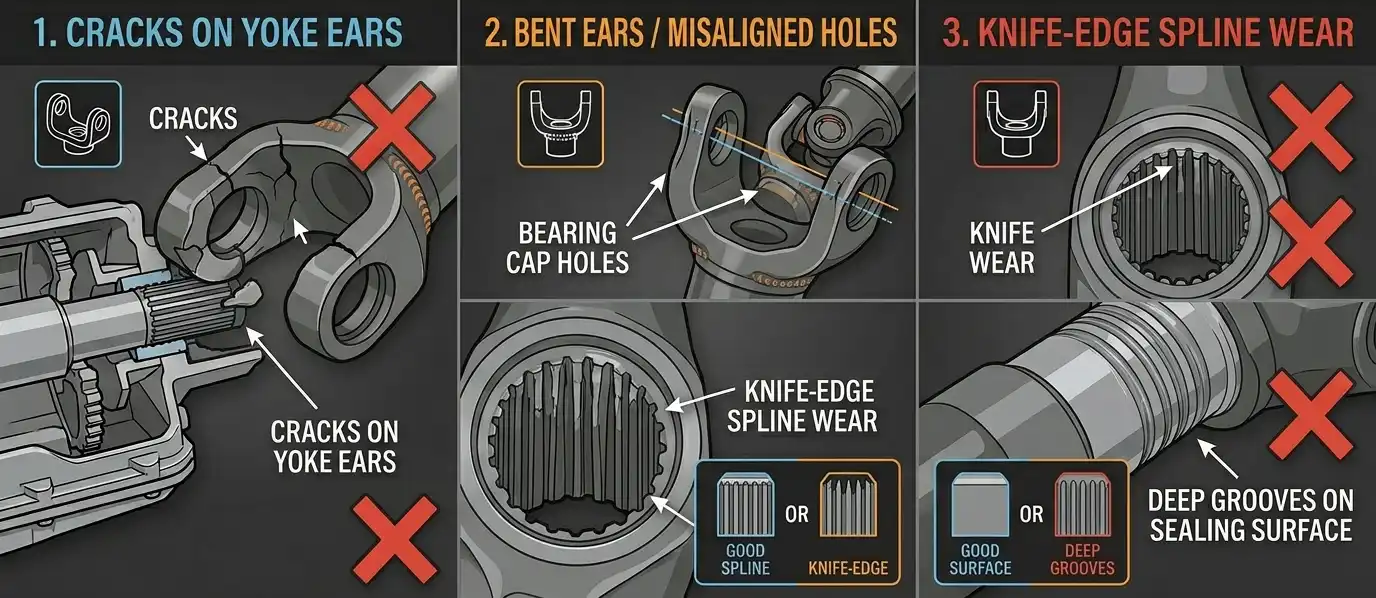
Replace the yoke immediately if any of the following conditions are found:
- Cracks or missing metal on the yoke ears
- Bent yoke ears or misaligned bearing cap holes
- Knife-edge spline wear
- Deep grooves on the sealing surface
Manual Play Inspection:
Raise the vehicle safely and grab the driveshaft near the yoke. Move it forcefully back and forth by hand. If noticeable movement exists, especially more than approximately 1/8 inch (3 mm), the yoke or U-joint is likely worn.
Once any of these symptoms appear, the yoke should be replaced as soon as possible. Delaying repair can damage the transfer case, differential bearings, or pinion gears, resulting in much higher repair costs.
How to Select the Right Yoke on Driveshaft
The core principle for yoke selection is straightforward: do not rely on appearance alone. Two yokes may look nearly identical while having completely different spline counts, dimensions, or U-joint compatibility.
Three specifications must always be confirmed before ordering:
| Parameter Category | Key Indicators | Description | Selection Advice |
|---|---|---|---|
U-Joint Specifications | Bearing cup diameter, retention method | Retention methods include inside snap rings, outside snap rings, or U-bolts. | Measure the bearing cup diameter of your current U-joint, confirm the retention type, and cross-check with the supplier. |
Spline Specifications | Tooth count, major diameter (outer diameter), pressure angle | Pressure angles are typically 30° or 45°. Splines with the same tooth count but different pressure angles will not mesh. | Count the spline teeth and measure the major diameter, which is the most reliable method for confirmation. |
Mounting Face Dimensions | Weld-end inner diameter, flange PCD (Pitch Circle Diameter), pilot diameter | Choose the corresponding mounting surface parameters based on the yoke type. | Measure the outer diameter of the driveshaft tube or the flange hole spacing to ensure an exact match with the mounting surface. |
When ordering a replacement yoke, it is recommended to provide the following information:
- OEM part number if available
- Spline tooth count and major diameter
- U-joint bearing cap diameter
- Snap ring style
- U-joint span width
- Clear front and side photos of the old yoke
If you're unsure which yoke fits your driveshaft, Zeke Parts offers OE cross-reference support across slip, weld, and flange yokes, as well as complete driveshaft assemblies. Contact us with your part number or photos, and we'll help confirm the right match.
Contact UsFrequently Asked Questions (FAQ)
Can a slightly worn yoke still be used?
It depends on the wear location and severity. Minor sealing surface wear can sometimes be polished and reused. However, spline wear exceeding 0.010 inch (0.25 mm) or any visible step usually requires driveshaft yoke replacement. Any crack in the yoke arms also requires immediate replacement.
How do I know which U-joint fits my yoke?
Measure three dimensions: the bearing cap diameter, the snap ring style, and the span width between bearing caps. Comparing these measurements with a U-joint specification chart will identify the correct model.
Zeke Parts offers U-joint series covering standard sizes such as 1310, 1330, 1350, 1410, and 1480. With accurate measurement details provided, Zeke Parts can help confirm the right fitment within 24 hours.
What is a yoke in a truck?
A truck yoke is a driveline component that connects the driveshaft to the transmission, transfer case, or differential. It transfers torque while allowing necessary movement in the drivetrain. Common types include slip yokes, which allow driveshaft length changes, and end yokes, which connect to the differential.
Is the factory slip yoke sufficient after lifting the vehicle?
For suspension lifts around 2–3 inches, the factory slip yoke is usually acceptable if driveline angles and travel remain within specification. For lifts exceeding 4 inches, evaluating a Slip Yoke Eliminator (SYE) setup is strongly recommended.
Conclusion
Driveshaft yokes are essential yet often overlooked driveline components responsible for torque transfer, universal joint mounting, and angle compensation. The four common yoke types feature different structures, connection methods, and application scenarios, each with its own advantages and limitations.
Yoke damage typically develops gradually and may cause knocking noises, vibration, and oil leaks. When selecting a replacement yoke, matching the correct specifications is essential for proper fitment and performance. If you have any questions about yoke replacement, Zeke Parts provides free technical support, including specification matching and application recommendations.