
A vehicle cannot move unless engine power is transferred to the wheels through the drivetrain system. This process involves several rotating components working together to deliver torque smoothly. Among these drivetrain components, the drive shaft and axle shaft are commonly misunderstood because both are involved in power delivery.
A drive shaft moves torque between drivetrain components, typically from the transmission to the differential, while an axle shaft moves torque directly to the wheels. Keep reading to see how they differ and why that difference matters when diagnosing vibration and drivetrain problems.
Table of Contents
What is a Drive Shaft?
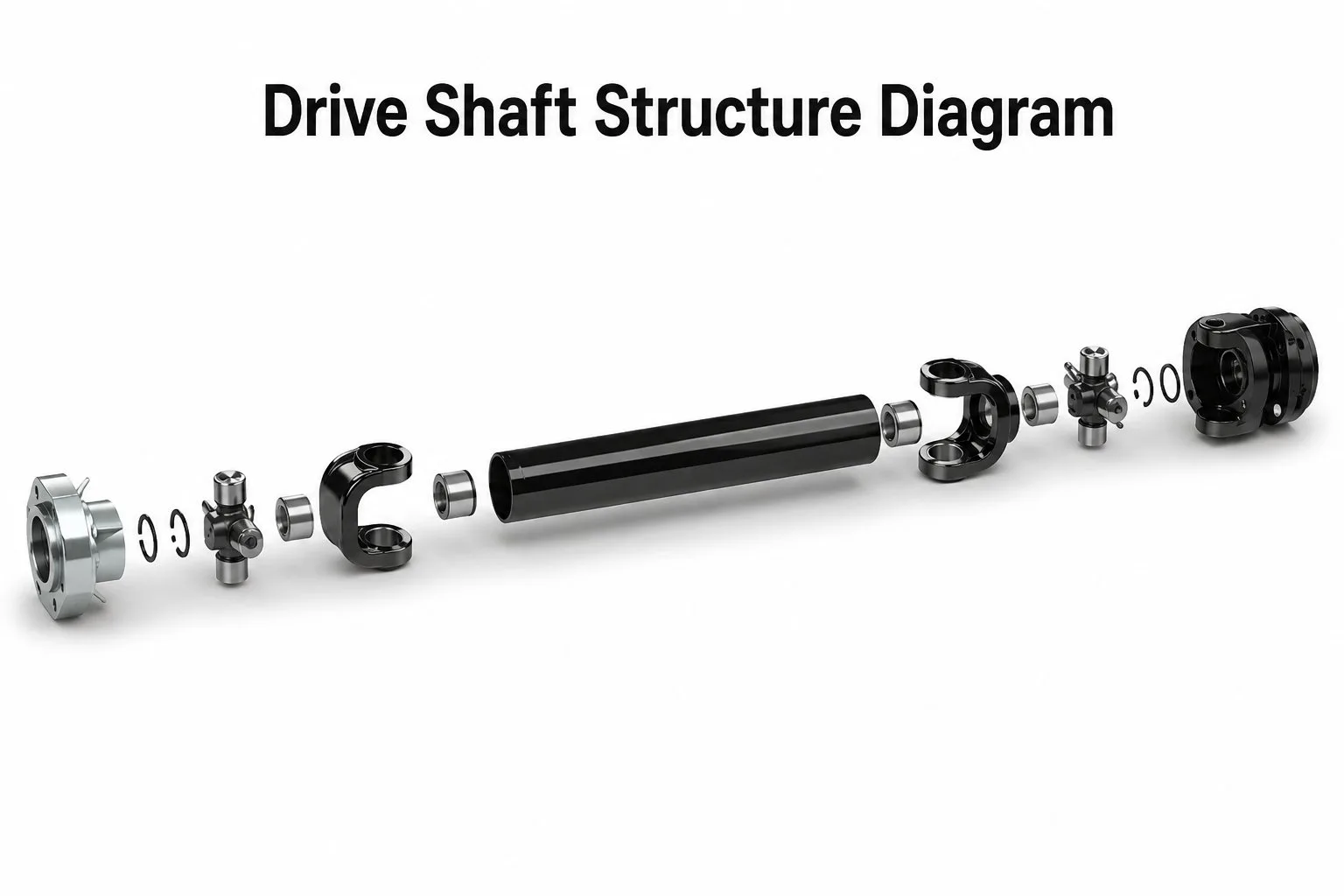
In RWD, AWD, and 4WD vehicles, a drive shaft is the long, tubular metal shaft that connects the transmission or transfer case to the differential, transferring torque across the longer distance between them. In British English, this component is usually called a prop shaft, while "drive shaft" more commonly refers to the axle shaft or half shaft. For a closer look at how the two terms differ by region, see drive shaft vs prop shaft.
It's built to handle constant rotation and high torque while the vehicle is moving. You can usually find it underneath the vehicle, running along the center of the chassis, and it plays a key role in transferring torque during acceleration, highway driving, or off-road driving.
What is an Axle Shaft?
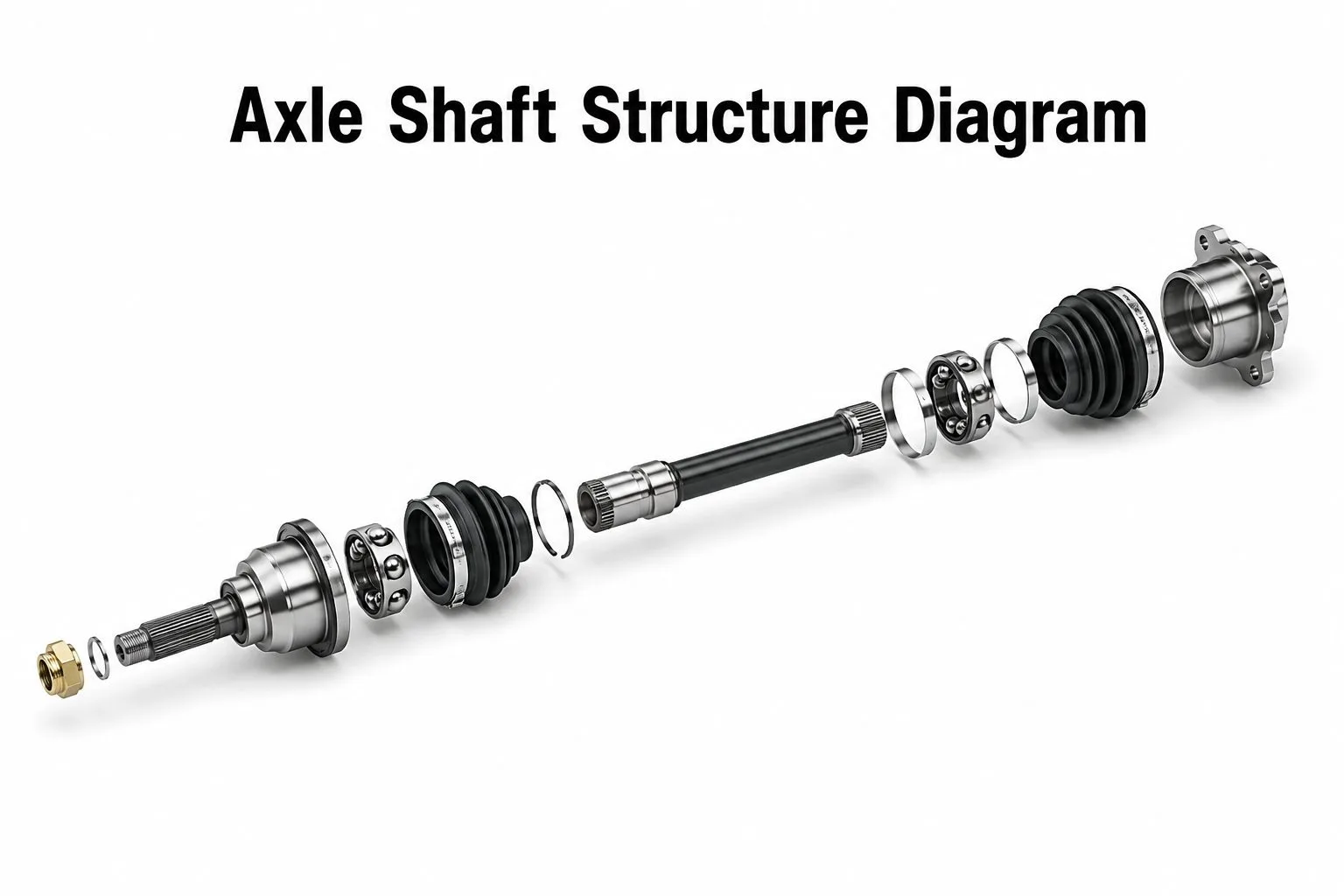
An axle shaft is a drivetrain component that directly transfers power from the differential or transaxle to the wheels. Unlike a drive shaft, which moves torque through the drivetrain, the axle shaft is the part that actually turns the wheels to move the vehicle. Most vehicles use axle shafts on the driven wheels, making them essential to acceleration and vehicle movement.
They are usually located near the wheels and connected to the hub assembly. During everyday driving, they continue to rotate as the vehicle accelerates, turns, or travels over uneven roads. Many modern vehicles also use CV joints on the axle shaft to allow smoother movement while the suspension and steering are in motion.
Because of this design, axle shafts are often called CV axles, especially in FWD vehicles where the axle shaft connects directly to the transaxle and front wheels.
Why People Confuse Drive Shafts and Axle Shafts
There are a few common reasons why these two parts are often mixed up. Each one comes from how they are described or used in vehicles.
Both Transfer Rotational Power
Both the drive shaft and axle shaft rotate while the vehicle is in motion, which is why they are often mentioned in similar contexts when discussing drivetrain behavior. This surface-level similarity can make them appear closely related, especially for those who are not familiar with vehicle structure.
However, the similarity stops at motion. The drive shaft is installed along the center underside of the vehicle between drivetrain sections, whereas the axle shaft is located at the wheel ends and connects directly to the wheel assembly.
Both Are Part of the Drivetrain
These components are often confused because they occupy similar positions within the drivetrain and serve the same overall function. Both sit within the chassis and are part of the same power flow, linking the transmission and differential to the wheels. As a result, their roles can appear closely related at first glance.
The difference becomes clearer when looking at how each operates. A drive shaft links major drivetrain units and transfers torque across the vehicle. An axle shaft, by comparison, operates at the final stage, delivering power directly to the wheels. The distinction is therefore not just about location, but about how each component functions within the overall drivetrain structure.
Terminology Confusion in Different Drivetrain Layouts
Another common source of confusion lies in how modern drivetrain layouts are designed. In many front-wheel-drive (FWD) vehicles, there is no traditional long drive shaft running from the transmission to a rear differential.
Instead, a transaxle delivers power directly to the front wheels through axle shafts, often called half shafts. Because these are the primary components transferring power, they are often casually referred to as "drive shafts", even though they are technically different parts.
In rear-wheel-drive (RWD) and all-wheel-drive (AWD) systems, the distinction is more straightforward. A drive shaft connects the transmission or transfer case to a differential, while axle shafts carry power from the differential to the wheels.
Key Differences Between Drive Shafts and Axle Shafts
To better understand the differences between them, the table below compares the drive shaft and axle shaft side by side.
| Feature | Drive Shaft | Axle Shaft |
|---|---|---|
| ⚙️ Main Role | Transfers torque between major drivetrain components | Delivers torque directly to the driven wheels |
| 📍 Location | Runs along the center underside of the vehicle | Located near the wheel hub assemblies |
| 🛞 Directly Connected to Wheels | ❌ | ✔️ |
🔄 Movement During Driving | Rotates in a fixed path under the vehicle | Moves with steering and suspension travel |
| 🔩 Common Joints | Usually uses U-joints | Commonly uses CV joints |
| 🚗 Common Vehicle Layouts | Common in RWD and AWD systems | Common in FWD and AWD systems |
Rather than replacing one another, the drive shaft and axle shaft work together within the same drivetrain system, mainly in rear-wheel-drive and all-wheel-drive vehicles. One component helps carry rotational force across different sections of the vehicle, while the other manages the final connection near the driven wheels.
Because their responsibilities are separated, wear or failure in either component can affect overall drivetrain performance. For this reason, drivetrain component quality plays an important role in long-term vehicle reliability.
As one of the best drive shaft manufacturers, Zeke Parts builds each drive shaft assembly with high-strength alloy steel tubing for durability under heavy load. It's balanced to under 10 g·cm at up to 4000 rpm, reducing vibration and wear. Lengths range from 1500 mm to 3000 mm, with OEM custom sizing to match your installation, and products cross-reference major brands such as Spicer, SKF, and Neapco for easier replacement.
Strengths and Limitations of Each Shaft
Because the drive shaft and axle shaft operate in different parts of the drivetrain, they are built to handle different types of movement and load. As a result, each component has its own strengths as well as limitations during driving.
Drive Shaft
Strengths of the Drive Shaft:
- Stable power transfer: Because the drive shaft runs in a fixed path beneath the vehicle, it can transfer rotational force smoothly across longer drivetrain sections with relatively stable alignment.
- Durable under heavy load: Drive shafts are usually built with strong metal construction to manage continuous torque during highway driving, towing, or off-road use.
Limitations of the Drive Shaft:
- Sensitive to imbalance: Since the drive shaft rotates at high speed through the center of the vehicle, even a small imbalance or bending can create noticeable vibration.
- Joint wear over time: Parts such as U-joints and support bearings experience constant rotational stress, which can gradually lead to looseness or wear after long-term use.
Axle Shaft
Strengths of the Axle Shaft:
- Direct wheel response: Because the axle shaft connects directly to the wheel hub, it transfers rotational force to the wheels immediately during acceleration.
- Works during steering and suspension movement: In many vehicles, the axle shaft must continue operating while the wheels turn and the suspension moves up and down, especially in FWD systems.
Limitations of the Axle Shaft:
- CV boots can crack with age: The rubber boot around the CV joint is constantly exposed to heat, moisture, and road debris, which can eventually cause cracking or grease leakage.
- More exposed to road impact: Since the axle shaft is positioned close to the wheels, potholes and rough road conditions can place additional stress on the shaft and joints.
Symptoms of a Bad Drive Shaft or Axle Shaft
Drivetrain problems often become noticeable through vibration, noise, or unusual vehicle behavior during driving. In many cases, drivers first notice problems during acceleration, turning, or highway driving. Identifying where and when the symptom appears can help narrow down which component may be causing the issue.
- Shudder at higher speeds: Severe wear in the drive shaft or its joints can cause a shudder that becomes more noticeable as speed increases.
- Clunk under throttle: Excessive play in the drive shaft may create a clunk when power is applied.
- Whole-body vibration: A bent or unbalanced drive shaft can send vibration through the vehicle during acceleration.
Bad axle shaft symptoms:
- Uneven wheel feel: A worn axle shaft or CV joint can create a rough or unstable feel at the wheel during acceleration.
- Clicking during turns: Damage in the axle shaft assembly may make the vehicle feel like it pulls or loads unevenly under power.
- Grease leakage near the wheel: A torn CV boot may leak grease around the inner wheel area.
Drive Shaft vs CV Axle Vibration During Acceleration
Among these bad drive shaft and axle shaft symptoms, vibration during acceleration is one of the easiest to notice and compare. A worn CV axle often produces vibration near the front wheels or steering area, especially during acceleration or turning. Drivers may also feel a rough or unstable sensation at the wheel, and the vibration can become more noticeable when the vehicle is under load.
In contrast, a bad drive shaft usually creates vibration through the center floor area of the vehicle, especially at higher speeds or under heavy acceleration. Drivers may notice vehicles shaking more as speed increases on the highway. Continued vibration can eventually make drive shaft replacement necessary if the shaft or drivetrain joints become excessively worn.
If your symptoms point to the drive shaft, Zeke Parts supplies OE-fit drive shaft assemblies and related components, such as slip yokes, flanges, and center supports. These parts fit a wide range of applications, from heavy-duty pickups such as the Ford F250 (1999–2006) and SUVs such as the Mercedes-Benz ML-Class (1999–2005) to agricultural and construction equipment.
If you're not sure whether we carry what you need, reach out to us and we'll help you find the right fit.
Contact UsFrequently Asked Questions (FAQ)
Is a drive shaft and axle the same thing?
No. An axle shaft transfers torque from the differential to the driven wheels, while a drive shaft transfers rotational force between drivetrain components, such as the transmission and differential. They are designed differently because they handle different motions.
Axle shaft assemblies often use CV joints to accommodate steering and suspension travel, while drive shafts use U-joints and slip yokes to accommodate suspension movement and length changes.
What does the drive shaft do?
The drive shaft carries rotational force from one drivetrain component to another so engine power can continue moving through the vehicle. In many RWD, AWD, and 4WD systems, it connects parts that are physically separated by a longer distance underneath the chassis. As the shaft rotates, it helps maintain continuous power flow while the vehicle accelerates or travels at higher speeds.
How many axle shafts does a car have?
Axle shaft count depends on which wheels receive power. A typical FWD vehicle usually has two front axle shafts, while many RWD vehicles use two rear axle shafts connected to the drive axle. AWD and 4WD systems normally use additional axle shafts because both the front and rear wheels receive torque. Some drivetrain designs may also use different axle shaft lengths depending on vehicle layout.
Summary
When comparing drive shaft vs axle shaft differences, the most important point is that the two components perform separate but connected roles within the drivetrain, especially in rear-wheel-drive and all-wheel-drive vehicles. The drive shaft mainly transfers rotational force between major drivetrain sections, while the axle shaft delivers that force directly to the driven wheels.
Getting this distinction right matters when sourcing the correct part or troubleshooting a drivetrain issue. Zeke Parts supports wholesalers, distributors, and repair professionals worldwide with OE cross-reference support and technical consultation. Responses are typically provided within 24 hours, helping you keep sourcing decisions and repair timelines on track.