
The driveshaft plays an essential role in any vehicle. It transfers power from the transmission to the differential, directly affecting drivetrain efficiency, vehicle performance, and driving stability.
The one-piece driveshaft has become increasingly popular due to rising demand for higher-performance vehicles, the growth of off-road modifications, and the need for high torque solutions. It offers several core advantages, including lighter weight, fewer components, reduced vibration, and better high-speed performance.
If you are not yet familiar with the one-piece driveshaft, keep reading this post. This article covers the definition, benefits, applications, materials, and key selection factors for one-piece driveshafts.
🔗 You May Also Like:
What Is a Drive Shaft in a Car? And How Does It Work?
Table of Contents
What Is a 1 Piece Driveshaft?
A one-piece driveshaft is a driveline component made from a single continuous tube. It transfers power directly from the transmission to the differential without using a center support bearing. Compared to a two-piece design, the one-piece driveshaft is simpler. It contains fewer parts and eliminates intermediate bearings and mounting brackets.
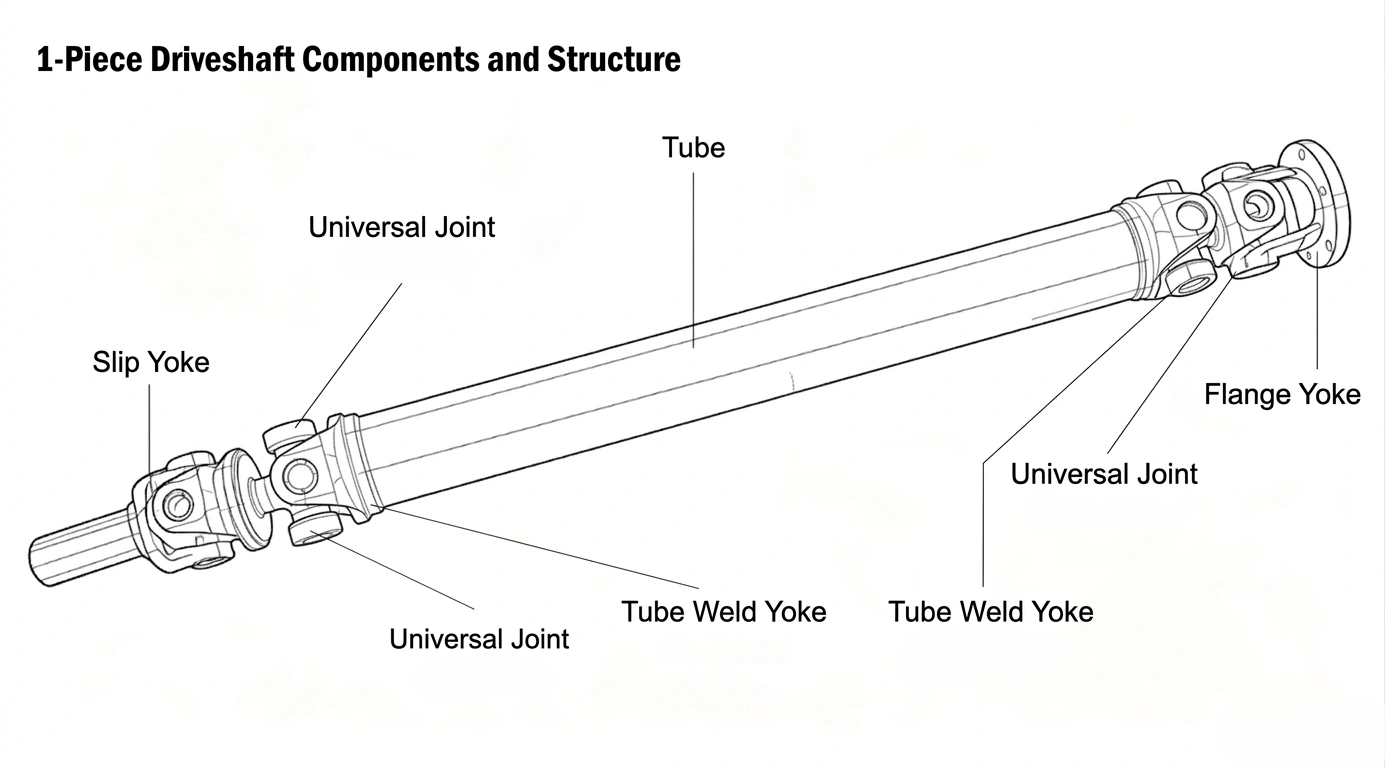
The basic structure includes 3 main parts: a shaft tube made of steel, aluminum, or carbon fiber; universal joints at both ends for smooth power delivery at different angles; and end fittings such as a slip yoke and flanges for secure connection to the transmission and differential. These end fittings, particularly the driveshaft yoke, work in conjunction with the universal joints to accommodate movement and transfer torque smoothly.
In operation, the one-piece driveshaft rotates at high speed to transmit torque. The transmission sends rotational force to the shaft, which then delivers power steadily to the rear axle or a four-wheel drive system. With no center support bearing or intermediate joint, the power transfer path is completely direct. This improves drivetrain efficiency by reducing energy losses and lowering mechanical complexity, resulting in fewer potential failure points over the life of the vehicle.
Core Benefits of a 1 Piece Driveshaft
The one-piece driveshaft offers several distinct advantages over multi-piece designs. These benefits make it an attractive choice for performance vehicles, trucks, SUVs, and off-road applications. Let us explore the four primary benefits in detail.
Reduced Weight
Weight reduction is one of the most compelling reasons to choose a one-piece driveshaft. The single tube design eliminates multiple components found in two-piece assemblies.
- Fewer components mean less mass. A two-piece driveshaft requires a center support bearing, a bearing bracket, rubber isolators, and additional hardware. Removing these parts significantly reduces the total weight of the driveline, which directly improves fuel efficiency and vehicle handling.
- Lower rotational mass improves drivetrain efficiency. A lighter shaft requires less energy to spin up to speed. This frees up horsepower that would otherwise be absorbed by a heavier rotating assembly, allowing more engine power to reach the wheels.
- Improved acceleration response is a direct result of reduced rotating mass. With less inertia to overcome, the engine can rev more freely and respond more quickly to throttle inputs. This gives the driver a sharper, more immediate feeling of power delivery.
Simplified Driveline Design
A simpler design leads to better reliability and lower costs. The one-piece driveshaft embodies this principle perfectly.
- No center support bearing is required. This eliminates a component that often fails or needs replacement in two-piece designs.
- Fewer moving parts mean less that can go wrong. Every additional component introduces potential failure modes, so fewer parts directly translate to greater dependability.
- Simplified structure makes installation more straightforward. With fewer components to assemble and align, the process takes less time and requires less specialized knowledge.
Reduced Driveline Vibration
Vibration can cause driver fatigue, premature component wear, and safety concerns. The one-piece design helps minimize vibration in several ways.
- Fewer joints reduce misalignment risks. Each additional joint in a two-piece shaft introduces a potential source of vibration.
- Continuous shaft delivers smoother power. Interruptions at center bearings can create torque variations that lead to driveline shudder.
- A single tube is easier to balance. Balancing two separate pieces to work perfectly together at high speeds is more challenging than balancing one tube.
Better Reliability and Easier Maintenance
Long-term reliability and maintenance ease are important considerations for any vehicle owner. The one-piece driveshaft excels in both areas.
- Full shaft visibility speeds up inspection. With no hidden components, you can quickly check for damage or wear without dismantling anything.
- Lower maintenance frequency reduces ownership costs. Fewer moving parts mean less regular servicing and fewer replacement items over the vehicle’s life.
- A simpler design means easier troubleshooting. When problems do occur, identifying the root cause is faster with fewer components to test and eliminate.
Common Applications of 1 Piece Driveshafts
Different vehicles require different driveline characteristics. The one-piece driveshaft adapts well to performance cars, pickup trucks, and off-road SUVs for distinct reasons.
Performance & Racing Vehicles
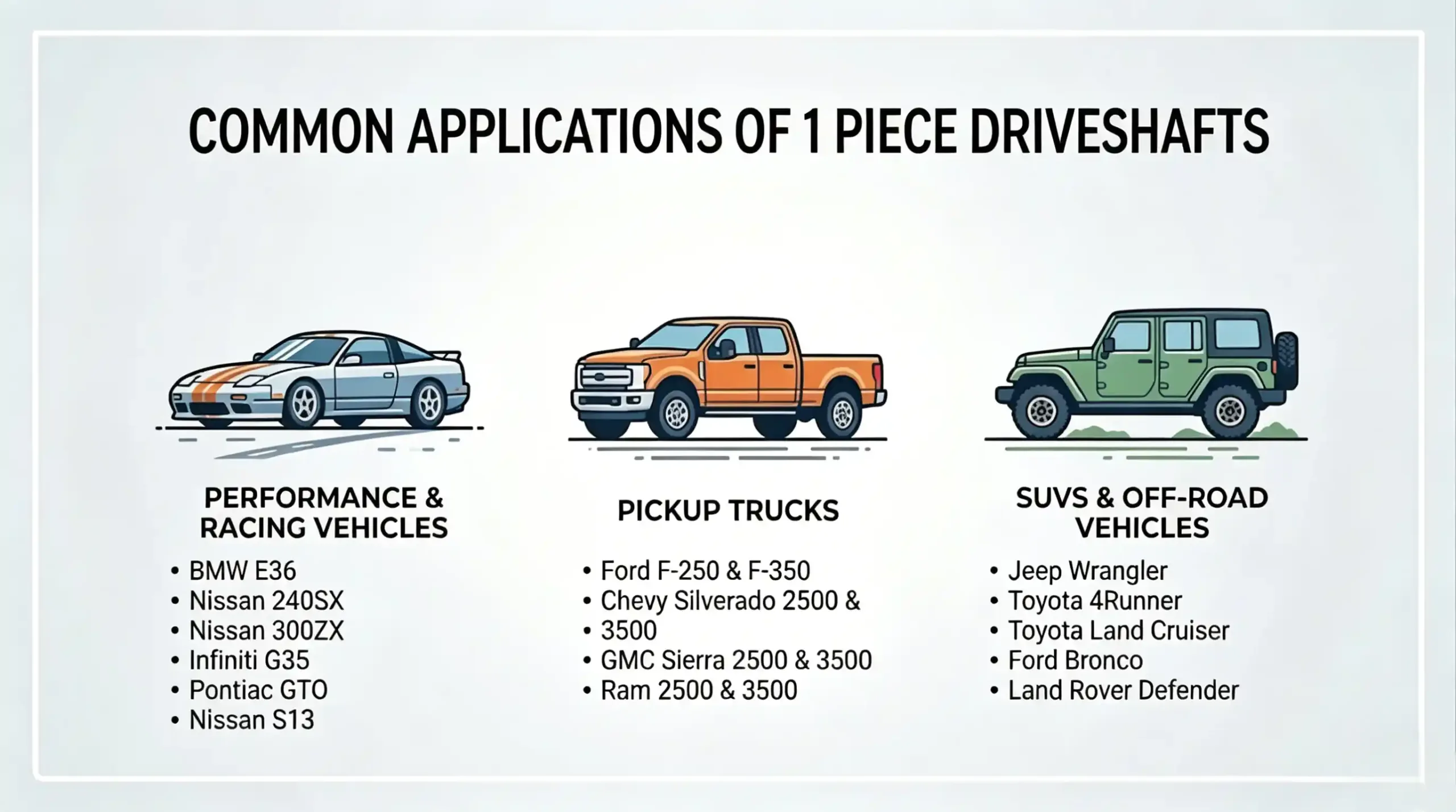
One-piece driveshafts are widely used in performance cars and racing vehicles. Common examples include the BMW E36, Nissan 240SX, Nissan 300ZX, Infiniti G35, Pontiac GTO, and Nissan S13. These vehicles demand lightweight components and high-speed stability. The one-piece structure reduces rotating mass, which improves acceleration response. It also provides smoother power delivery at high engine speeds. For drivers who push their cars to the limit, the one-piece driveshaft is an excellent choice.
Pickup Trucks
In the pickup truck segment, one-piece driveshafts are often used for towing, hauling, and performance upgrades. Common applications include the Ford F-250 and F-350, Chevy Silverado 2500 and 3500, GMC Sierra 2500 and 3500, and Ram 2500 and 3500. These trucks require driveshafts that can handle high torque output while maintaining structural stability. The one-piece design meets these demands effectively. It is suitable for both factory installations and aftermarket modifications.
SUVs & Off-road Vehicles
For SUVs and off-road vehicles, the one-piece driveshaft improves drivetrain efficiency and reliability. Common models include the Jeep Wrangler, Toyota 4Runner, Toyota Land Cruiser, Ford Bronco, and Land Rover Defender. These vehicles often encounter rough terrain and significant suspension movement. The simplified structure of a one-piece driveshaft helps reduce failure points. It also maintains power delivery stability under challenging conditions. These characteristics enhance overall off-road performance.
Common Materials Used
The choice of material for a one-piece driveshaft significantly affects its performance, weight, and cost. Here are the three most common options.
- Steel Driveshafts: High strength and excellent durability for heavy torque loads. Ideal for trucks, commercial vehicles, and OEM applications. Steel is affordable and reliable for heavy-duty use. For applications requiring exceptional torsional strength and load-carrying capacity, Zeke Parts offers high-quality alloy steel driveshafts to ensure structural integrity under demanding conditions.
- Aluminum Driveshafts: Significantly lighter than steel, improving acceleration response and fuel efficiency. Aluminum also offers good corrosion resistance. This makes it a popular choice for performance vehicles, SUVs, and modified cars seeking a balanced upgrade without the high cost of carbon fiber.
- Carbon Fiber Driveshafts: The ultimate choice for weight reduction and strength. Carbon fiber reduces rotating mass, minimizes vibration, and improves high-speed stability. It comes at a higher cost and is typically reserved for high-end performance cars and racing applications.
Key Factors to Consider Before Choosing One
Selecting the right one-piece driveshaft requires careful consideration of several factors. The following guidelines will help you make an informed decision.
- Vehicle Wheelbase: Shorter wheelbases in compact cars and performance vehicles are well-suited for one-piece driveshafts. Longer wheelbases in trucks and SUVs are more prone to vibration and critical speed issues, and may require a two-piece configuration.
- Torque Requirement: Medium torque applications like street performance cars and light trucks can use standard steel or aluminum shafts. High torque applications such as Cummins diesel engines or Dodge 2500 pickup trucks need higher strength steel shafts or larger tube diameters.
- Application Type: Lightweight materials like aluminum or carbon fiber are more suitable for performance and racing vehicles. Pickup trucks favor durability and load capacity, making steel the preferred choice, while off-road vehicles need impact resistance and reliability. For industrial and heavy-duty applications, Zeke Parts offers driveshafts with optimized structural design to ensure long-term operational stability and reduce unplanned downtime.
- Material Selection: Steel works best for heavy-duty and OEM applications, while aluminum is ideal for lightweight upgrades and daily driving performance. For high-end performance vehicles and racing applications, carbon fiber is the most suitable option.
Frequently Asked Questions (FAQ)
How long can a 1-piece driveshaft be?
The maximum length of a one-piece driveshaft is primarily limited by critical speed and vehicle wheelbase. A one-piece design generally works well for short to medium wheelbase vehicles. When the wheelbase becomes too long, a single shaft is more likely to develop vibration and resonance problems. For long wheelbase vehicles, manufacturers typically use a two-piece design to maintain high-speed stability.
What is the difference between 1-piece and 2-piece driveshafts?
A one-piece driveshaft uses a single continuous tube with no center support bearing. This design offers simplicity, lighter weight, and more direct power transfer. A two-piece driveshaft divides the shaft into two sections joined by a center support bearing. The two-piece design helps manage vibration and is better suited for long wheelbase vehicles and complex chassis layouts.
Summary
The one-piece driveshaft offers a compelling combination of lighter weight, simpler design, reduced vibration, and improved reliability. It is an excellent choice for performance vehicles, pickup trucks, SUVs, and off-road applications. Understanding your vehicle wheelbase, torque requirements, intended use, and material preferences will help you select the right shaft for your needs.
Zeke Parts offers custom one-piece driveshafts based on your equipment model, dimensions, or industrial requirements. Whether you need a standard replacement or a custom driveshaft, contact us. Our team responds within 24 hours to help you find the right driveshaft.
Contact Us