
Vibration under the seat, clunking during gear changes, or high-speed shudder are some of the most common signs associated with drive shaft problems. In many cases, these early symptoms are difficult to identify correctly and are frequently mistaken for tire imbalance, engine misfire, worn transmission mounts, or other driveline issues.
This overlap makes drive shaft problems one of the most commonly misdiagnosed issues in chassis repair. Misdiagnosis leads to unnecessary replacements, wasted time and money, and in severe cases, a failing shaft that becomes a safety risk at highway speeds.
That is why getting the diagnosis right from the start matters. By reading this guide, you will understand the most common bad drive shaft symptoms, how to distinguish them from similar driveline issues, and when repair or replacement is actually necessary.
Table of Contents
Signs of a Bad Drive Shaft
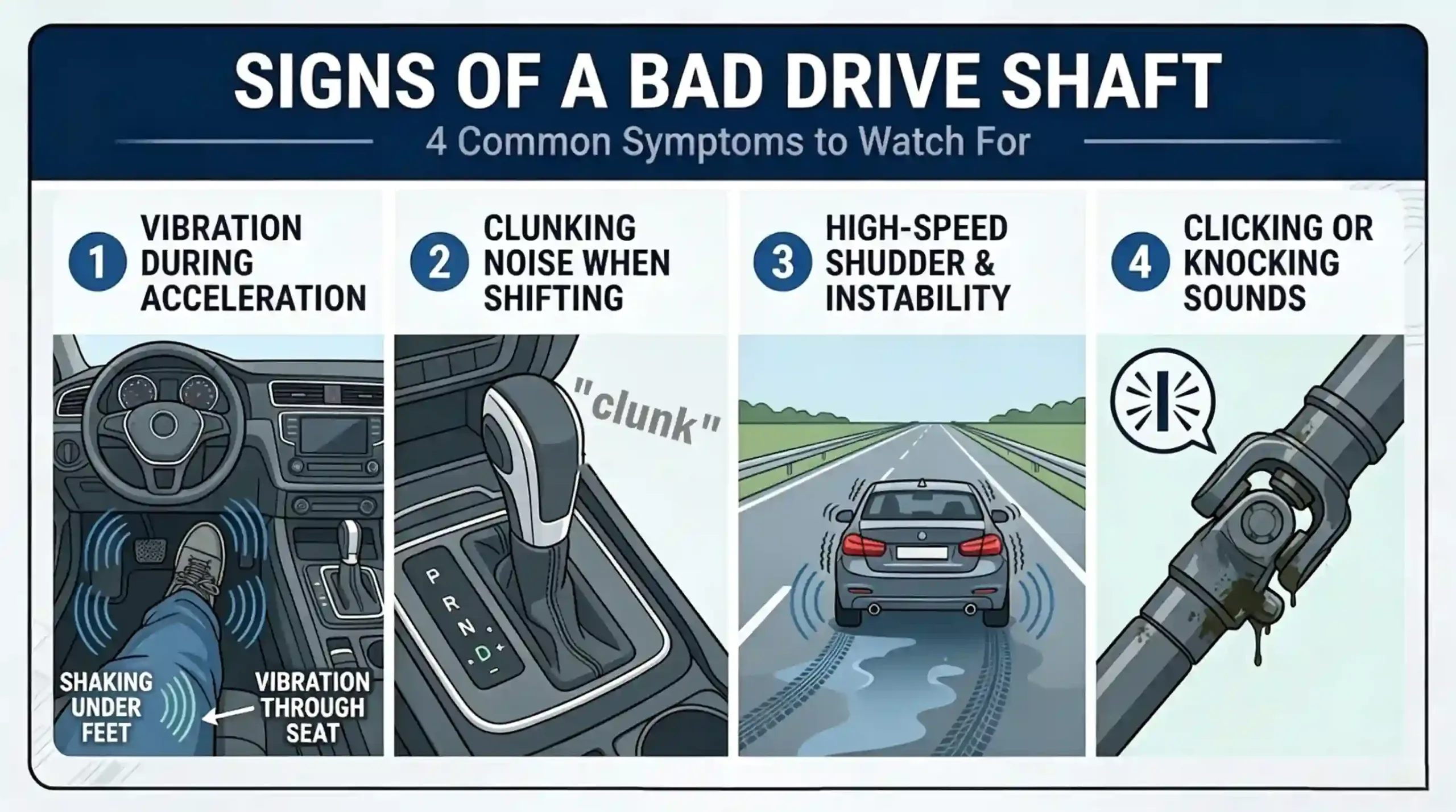
Not every noise or shake points to the drive shaft. But certain patterns strongly suggest it. The following 4 symptoms are the most common indicators of drive shaft trouble.
Drive Shaft Vibration During Acceleration
Vibration that occurs mainly during acceleration is one of the clearest signs. You may feel this shaking under your feet or through the seat. It often becomes more noticeable at medium to high speeds. In some cases, the vibration fades when you let off the gas pedal.
This symptom is typically linked to worn universal joints, an out-of-balance drive shaft, or incorrect driveline angles. Worn universal joints often produce vibration that peaks at specific speeds, while imbalance tends to cause vibration that worsens progressively as speed increases. Incorrect driveline angles, on the other hand, usually create vibration that changes with acceleration force.
Clunking Noise When Shifting or Accelerating
A clunk or thud that happens when you shift into Drive or Reverse is a strong warning sign. You might also hear it the moment you press the gas pedal from a stop. The noise is most noticeable when the power suddenly engages.
This clunk usually comes from loose universal joints, excessive play in the slip yoke, or general driveline slack. Loose universal joints tend to produce a single sharp clunk as the slack is taken up. With excessive slip yoke play, the noise is often more of a muffled thud. In cases of general driveline slack, you may hear multiple clunks or even a brief rattling sound when power is applied.
High-Speed Shudder and Driveline Instability
Once your vehicle reaches about 60 miles per hour, it may develop a persistent shake or shudder. You may also feel a sense of instability, as if the rear of the car is wandering or vibrating. This is often described as high-speed shudder.
The most common causes are drive shaft imbalance, incorrect driveline angles, or misalignment between components. At higher rotational speeds, even small imbalances become much more noticeable. For example, imbalance-related shudder typically feels like a smooth, consistent vibration. In contrast, incorrect angles often produce a more violent shake that may come and go with acceleration or deceleration, while misalignment tends to cause a shudder felt more in the chassis than through the seat.
Clicking or Knocking Sounds From the Driveline
If you hear clicking or knocking noises when driving at low speeds or while turning, the drive shaft or its joints may be at fault. These sounds often become faster as the vehicle speeds up.
Clicking is typically caused by dry or worn universal joints. The lack of lubrication allows metal-on-metal contact, which produces a distinct click or knock with each rotation. A single sharp click per rotation often indicates one worn cup, while multiple clicks or a rough grinding sound suggests more widespread joint failure.
To help pinpoint the source, listen to whether the clicking gets faster with vehicle speed. If it does, the issue may involve the driveshaft or another rotating drivetrain component.
Drive Shaft Inspection and Diagnosis
Once you have identified a potential symptom, the next step is a systematic inspection. The following 3 approaches will help you confirm whether the drive shaft is truly the source of the problem.
Visual Inspection
Visual inspection should be part of any regular maintenance routine. Focus on the areas most likely to show early signs of failure.
- Check boots and clamps: You should look for torn, loose, or hardened rubber boots. Damaged boots are the most frequent cause of drive shaft failure because they allow dirt to enter and let grease escape.
- Look for grease leaks: Any oil or grease residue on the drive shaft, boots, or nearby components is a clear sign of internal damage.
- Inspect for damage and bending: You should examine the shaft tube for visible bends, dents, or missing parts. Even minor damage can lead to imbalance and vibration.
Road Test Diagnosis
A careful road test allows you to listen and feel for the specific patterns described earlier.
- Turning noises: Clicking or knocking sounds during turns usually point to worn joint internals, such as ball track damage.
- Grinding sounds: A grinding noise during straight driving or acceleration may indicate excessive rotational play between a joint and the shaft.
- Steering wheel vibration: If the vibration in your steering wheel increases with vehicle speed, the likely causes are loose universal joints or a bent, unbalanced drive shaft.
Lift Inspection
For the most reliable diagnosis, the drive shaft should be removed and inspected off the vehicle.
- Use soft jaw clamps: When securing the drive shaft in a vise, always use aluminum or soft jaws. Steel jaws will crush or damage the shaft tube.
- Check joint rotation: Rotate both universal joints by hand. They must move smoothly without any binding, grinding, or excessive radial play.
- Install a new nut: During reinstallation, the drive shaft nut at the wheel hub must be replaced with a new one. Tighten it to the manufacturer-specified torque. Never reuse an old nut.
Other Problems That Can Mimic a Bad Drive Shaft
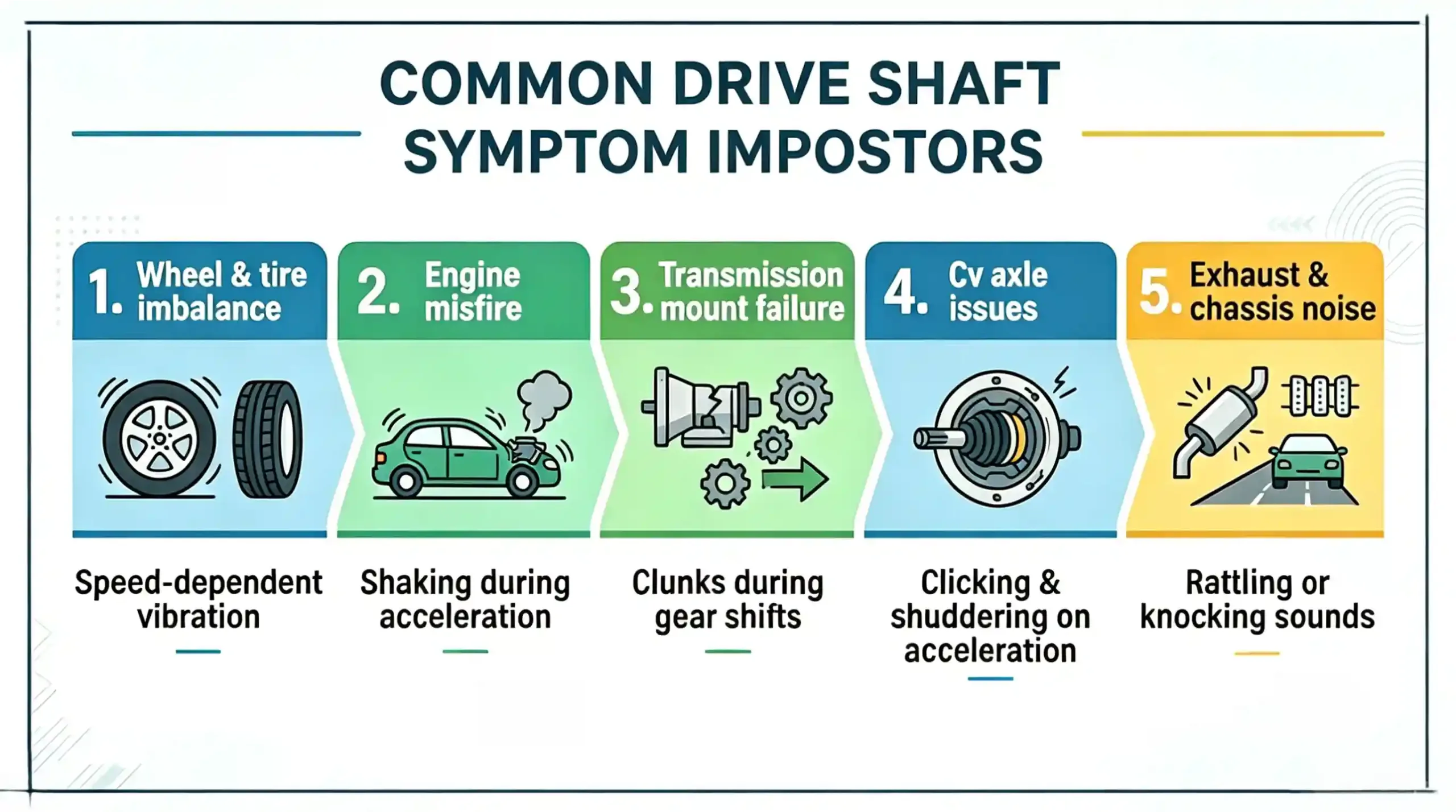
Several non-drive shaft issues can produce nearly identical symptoms. Here are the most common impostors.
- Wheel or Tire Imbalance: Vibration at medium to high speeds is often associated with wheel or tire imbalance and can feel very similar to drive shaft vibration. Unlike a drive shaft issue, however, the vibration is usually tied primarily to vehicle speed rather than acceleration or driveline load.
- Engine Misfire: If the vehicle shakes during acceleration, the engine may be the source rather than the driveline. Rough idle, power loss, or a check engine light are common clues that point toward a misfire instead of a drive shaft problem.
- Transmission Mount Failure: Clunking noises during gear changes are not always caused by a worn drive shaft. A damaged transmission mount can allow excessive drivetrain movement, creating similar impacts when shifting or applying throttle.
- CV Axle Issues: Clicking noises and shuddering during acceleration are frequently linked to worn CV joints. While these symptoms can resemble drive shaft failure, they typically become more noticeable when turning.
- Exhaust or Chassis Contact Noise: Sometimes, the noise is not coming from the driveline at all. Loose exhaust components or heat shields can create rattling or knocking sounds that change with engine speed, road conditions, or vehicle movement.
Similar symptoms do not always mean the same root cause. Misdiagnosing a drive shaft problem can lead to unnecessary repairs and wasted time. If you experience any of these symptoms, the best course of action is a thorough inspection at a professional shop. Pinpoint the true source before replacing any major components.
When to Replace a Drive Shaft
A complete drive shaft replacement is not necessary for every issue you may encounter. The correct solution depends on which component is damaged and how severe the damage is.
- Repair may be sufficient: If the issue is limited to a worn U-joint, center support bearing, or another serviceable component, replacing the affected part is often enough to restore normal operation.
- Replace individual driveline components: If the slip yoke, flange, drive shaft carrier bearing, or other attached hardware shows wear while the shaft tube remains straight and undamaged, replacing only the worn component may be a practical option.
- Replace the entire drive shaft: Replace the entire drive shaft if the shaft tube is bent, cracked, dented, or severely corroded. A complete replacement is also necessary when vibration remains after balancing and other possible causes have been eliminated.
- Replace immediately for safety reasons: Stop driving and replace the drive shaft if you find a cracked drive shaft tube, a severely worn U-joint with excessive play, missing balance weights, or any damage that could cause the shaft to separate and potentially fall out while the vehicle is moving.
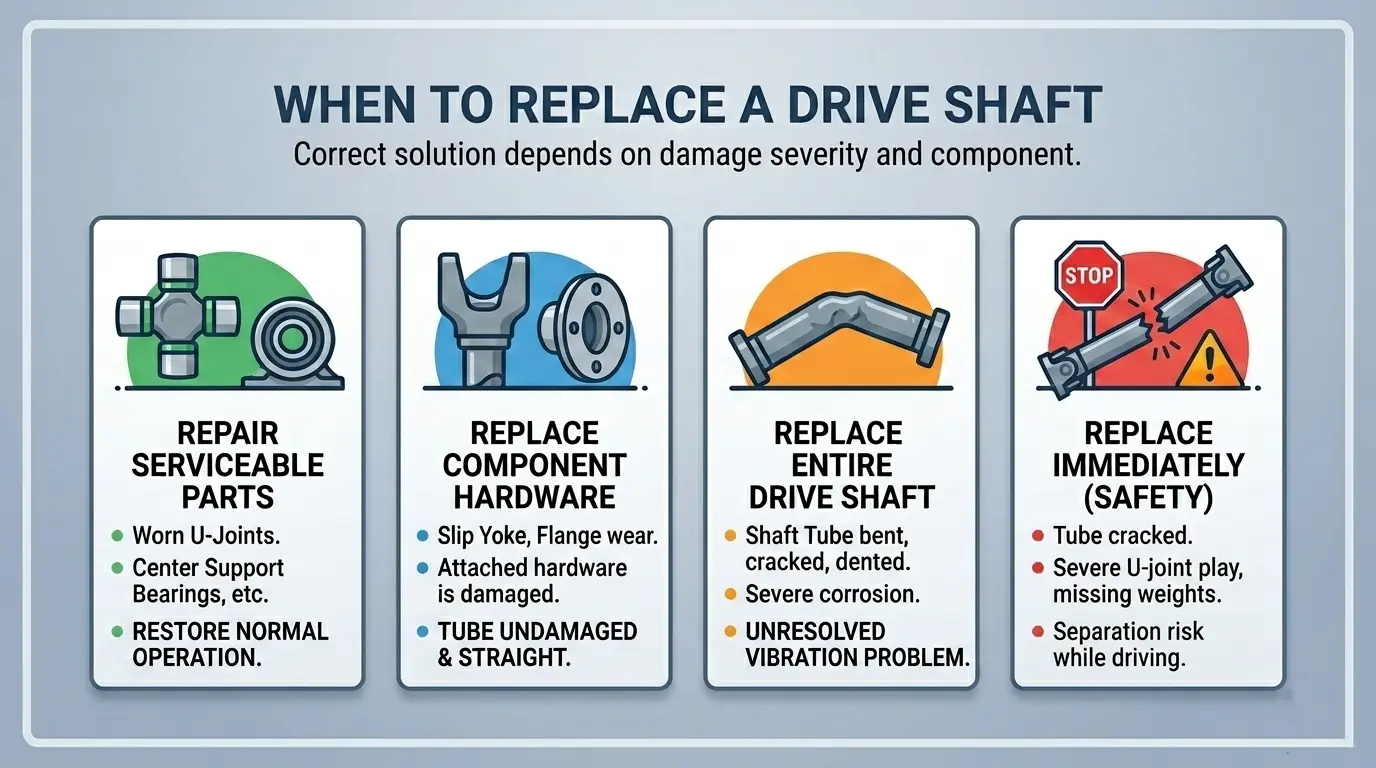
In general, replace repairable wear items when possible, but replace the entire assembly when structural damage or safety concerns are involved.
When replacement becomes necessary, choosing a high-quality product pays off. A great example is the drive shaft assemblies from Zeke Parts. They are built from high-strength alloy steel and are balanced to under 10 g·cm at 4,000 rpm for stable power delivery. The series provides custom lengths and surface treatments for durable, low-vibration performance. For the right fit for your equipment, reach out anytime.
Contact UsFrequently Asked Questions (FAQ)
What Happens When a Drive Shaft Fails?
When a drive shaft fails, power delivery from the transmission to the wheels is interrupted. You will likely notice severe vibration, loud clunking or banging noises, and a loss of driving force. In extreme cases, the shaft can break apart or detach. This may cause serious damage to the transmission, differential, fuel lines, brake lines, or the vehicle floor pan. It also creates a major safety hazard.
How Does a Drive Shaft Break?
Drive shaft damage is almost always the result of long-term wear or unusual stress. Common causes include universal joints that become stuck or loose, loss of balance that creates continuous vibration, rust and metal fatigue over time, and sudden overloads from high torque or off-road impacts.
Is It Worth Fixing a Drive Shaft?
It depends on the extent of the damage. If the problem is limited to a worn U-joint or another serviceable component, repair is often a cost-effective solution. However, if the shaft is bent, cracked, or severely out of balance, replacement is usually the safer and more reliable option.
Conclusion
Drive shaft problems often start with small vibration, noise, or driveline instability before developing into more serious failures. Identifying these warning signs early and following a proper inspection process can help avoid unnecessary repairs and costly damage.
If you are unsure about the diagnosis, you can contact Zeke Parts for professional advice. We offer a wide range of universal joints and drive shaft products in multiple specifications, along with custom solutions, so you can find a suitable match for different vehicles and equipment without compatibility concerns.