
For most stock applications, just use a standard Year, Make, and Model (YMM) lookup, you can easily identify the correct OEM-spec replacement. However, modified vehicles, axle swaps, and custom driveshaft projects often do not fit into any factory specs. The transmission, differential, and transfer case may come from different sources, so the original vehicle information is no longer useful.
In these situations, standard parts often cannot be used. Even if you find a U-joint with close dimensions through a size match, you may still run into problems. The two ends may not match, the dimensions may fall between two standard series, or the strength may not meet high torque demands. When standard parts and common conversion joints cannot solve the problem, you may need custom U-joints.
This article will walk you through custom U-joints. You will learn when customization is necessary, what parameters you need to provide, how to choose a sourcing channel, and how conversion U-joints can serve as a cost-effective alternative in many common scenarios.
Table of Contents
What Is a Custom U Joint
A custom U-joint is a universal joint selected or manufactured to meet specific driveline requirements. It solves the problem of a standard OEM or aftermarket U-joint not directly matching the application.
The main difference from standard OEM replacement joints lies in how you identify them. Standard OEM replacements rely on vehicle model and factory part numbers. Custom U-joints focus on actual physical dimensions, interface types, and driveline configurations. Key parameters include bearing cap diameter, overall width, and snap ring style. These details determine whether the joint will work with your specific setup.
Standard U-Joint Size vs. Custom Builds
Most custom U-joints are not designed entirely from scratch. Instead, they are usually developed from existing standard series. In many cases, customization involves modifying specific dimensions or retention features within a standard series, such as changing the bearing cap diameter on one end, adjusting the overall width, or selecting a different snap ring style. Another common approach is combining the dimensions of two standard series into a single assembly, creating what is known as a conversion U-joint.
This is why standard universal joint sizes serve as the foundation of most custom applications. Reviewing the common series and their dimensions can help determine whether a standard U-joint already meets the application requirements or whether a custom solution is truly necessary.
The table below shows some of the most widely used standard U-joint series and sizes.
| U-Joint Series | Bearing Cap Diameter | Overall Width | Typical Application |
|---|---|---|---|
1310 Series | 1.062 inch (26.97 mm) | 3.219 inch (81.76 mm) | Passenger cars, light-duty pickups |
1330 Series | 1.062 inch (26.97 mm) | 3.625 inch (92.08 mm) | Light towing, off-road vehicles |
1350 Series | 1.188 inch (30.18 mm) | 3.625 inch (92.08 mm) | Heavy towing, lifted trucks |
1410 Series | 1.188 inch (30.18 mm) | 4.188 inch (106.38 mm) | Heavy-duty pickups, commercial vehicles |
1480 Series | 1.375 inch (34.93 mm) | 4.188 inch (106.38 mm) | Commercial trucks, industrial equipment |
1550 Series | 1.375 inch (34.93 mm) | 4.625 inch (117.48 mm) | Extreme loads, racing applications |
A perfect match with a standard series often means a standard U-joint is all that is required. Measurements that fall between two standard series may call for a custom-sized U-joint. Where the two connection points belong to different series, such as 1310 on one side and 1350 on the other, a conversion U-joint is commonly used to accommodate the difference.
A perfect match with a standard series often means a custom joint is likely not needed.
Among all standard U-joint series, the 1310 series is the most common and widely used. For those looking for a reliable manufacturing partner, Zeke Parts offers a complete range of standard U-joint series, including the popular 1310 series. Its 1310 U-joints cross-reference numerous OEM and aftermarket part numbers, including Spicer 5-1310X, 5-467X, Neapco 1-0153G, GMB G5-467X, ACDelco 45U0145, and many others. This extensive interchangeability helps simplify replacement and sourcing across different brands and applications.
When Do You Need a Custom U Joint
Not every driveline problem requires a custom U-joint. For most factory vehicles, standard replacement parts are sufficient. You should consider a custom joint only in specific situations.
- Size Mismatch Between Components
When driveline components from different vehicles are used together, the connection dimensions may no longer match. Common examples include axle swaps, transmission swaps, and custom driveshaft projects. In these cases, a conversion U-joint or custom design may be required to bridge incompatible dimensions.
- Operating Angles Beyond Standard Limits
Vehicles with significant suspension modifications or operating in extreme conditions may place the U-joint at angles beyond the intended range for standard designs. Common examples include lifted trucks and off-road builds.
- Strength Requirements Beyond Standard Specifications
High-horsepower and high-torque applications can place additional stress on the driveline. When standard U-joints cannot provide the required strength or service life, a custom solution may be necessary.
- No Suitable Standard U-Joint Available
Some equipment and vehicles are built to dimensions that do not match any standard U-joint series. This is often the case with industrial machinery, agricultural equipment, older vehicles, and discontinued applications where replacement parts are no longer available.
What Information Do You Need for a Custom U-Joint
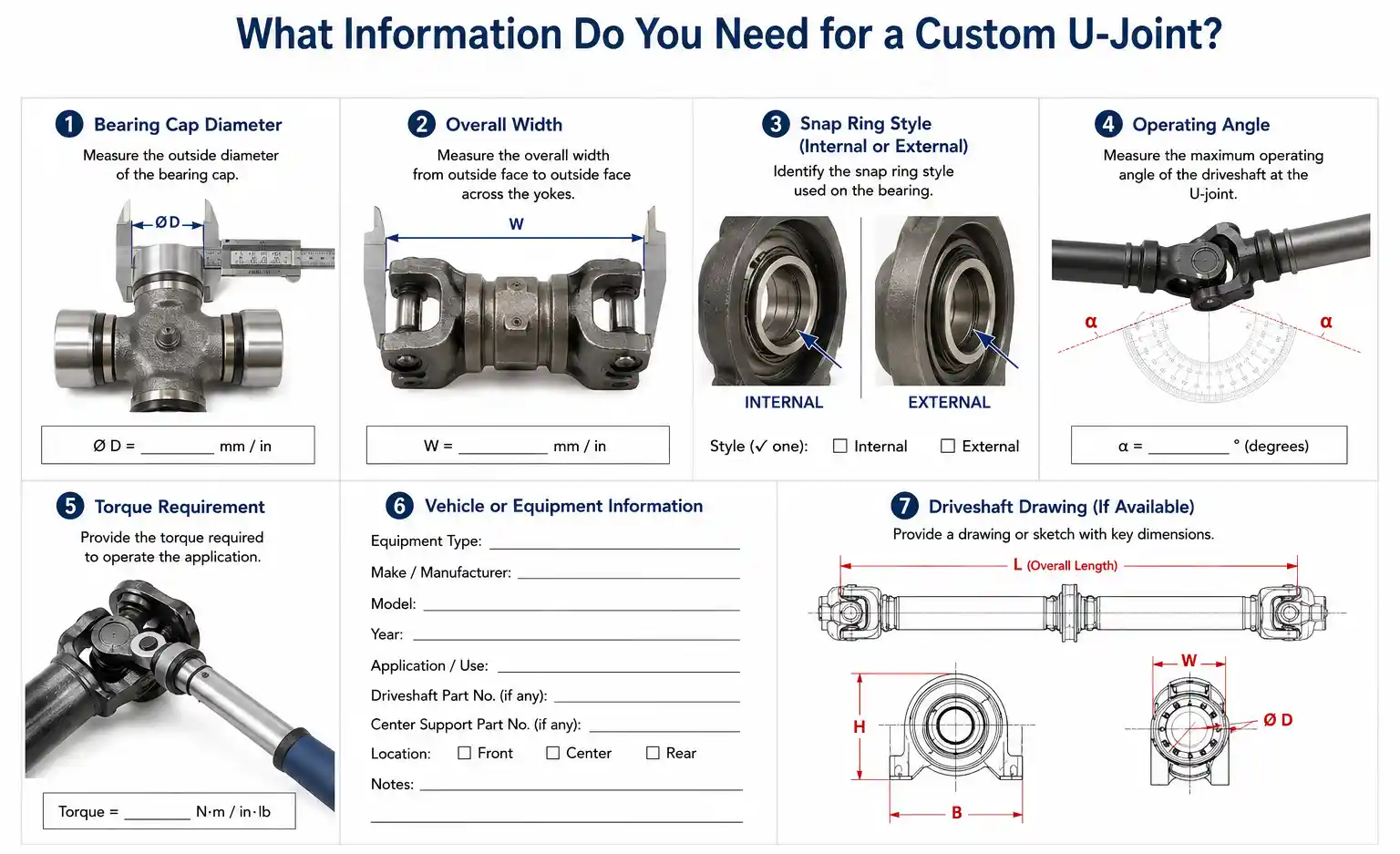
To order a custom U-joint that fits perfectly, providing the right information to your manufacturer is essential. The more detail you can share, the better the final product will match your needs. Most suppliers typically require the following parameters.
- Bearing cap diameter: Getting this measurement right is critical for a proper fit inside the yoke bore. A diameter that is too large will prevent installation altogether, while an undersized cap will introduce play and lead to vibration during operation.
- Overall width: This dimension tells you how much span the U-joint will have across the yoke. If the width is off, the snap rings may not seat correctly, or the joint could shift axially when under load.
- Snap ring style (internal or external): The way the U-joint is secured depends entirely on this specification. Choosing the wrong style can make installation impossible or, just as problematic, leave you unable to remove the joint later for service.
- Operating angle: Knowing the articulation range your driveline requires helps determine whether a standard joint will survive in that environment. When the operating angle exceeds what the joint can handle, accelerated wear and premature failure are almost certain.
- Torque requirement: This value helps determine the strength level required for the application. Selecting a U-joint with insufficient torque capacity can lead to premature wear, deformation, or even failure under heavy load.
- Vehicle or equipment information: Providing the make, model, and year gives the supplier useful context for cross-referencing existing specifications. Even better, it may uncover previous matching records that save you time and guesswork.
- Driveshaft drawing (if available): No other document delivers mounting dimensions and interface details with this level of accuracy. Submitting a drawing is the single most effective way to avoid communication errors and costly mistakes on custom orders.
Knowing which parameters to measure is only half the task. The accuracy of your measurements directly affects how well the custom joint will fit your application.
Why Accurate Measurements Matter
For a custom U-joint, even a small measurement error can lead to installation problems or driveline issues. Choosing the wrong bearing cap diameter, overall width, or snap ring style will affect how the joint sits in the yoke. Poor fit leads to several common problems.
- Vibration: An incorrect fit can throw off driveshaft balance or create improper operating angles, which then produce noticeable vibration.
- Premature wear: Abnormal loads accelerate wear on the bearings, cross shafts, and other driveline components.
- Installation issues: When dimensions are off, the joint may not seat properly. You may need to rework parts or replace yokes entirely.
Accurate U-joint measurement is the first step toward a correct fit. Only when you have reliable data can you determine which U-joint series your application belongs to. From there, you can search for a standard part, a conversion joint, or a fully custom solution.
Conversion U Joints: A Cost-Effective Alternative to Full Customization
Fully custom U-joints can be expensive. In many common scenarios, a full custom joint is not necessary. There is a special category of U-joint called a conversion U-joint. It allows you to solve interface mismatch problems at a lower cost and with a shorter lead time than going fully custom.
A conversion U-joint is a universal joint that uses different dimensions on its two perpendicular axes. It is specifically designed to connect driveline components that would not otherwise fit together.
You can consider a conversion U-joint instead of a full custom solution if the following conditions apply:
| Condition | Description |
|---|---|
Both Ends Match Standard U-Joint Series | The conversion U-joint can be installed without interference from surrounding components due to its dimensions or shape. |
Common Conversion Combination | These conversion combinations are common and easy to source. Popular examples are the 1310-to-1330, 1310-to-1350, 1330-to-1350, and 1350-to-1410. |
Sufficient Installation Clearance | The conversion U-joint can be installed without interference from surrounding components due to its dimensions or shape. |
Moderate Operating Conditions | Suitable for daily driving, light off-road use, and general towing applications. Extreme racing, heavy-duty commercial use, or other high-stress environments may require additional evaluation. |
If both sides fit into standard U-joint series and a suitable conversion combination is available, a conversion U-joint is often a practical solution. In many cases, it may be a suitable alternative to a fully custom U-joint.
There are several common scenarios where conversion U-joints become especially useful. For example:
- Engine or transmission swap: When you install a modern LS or Coyote engine into an older vehicle, the new transmission output flange often does not match the original driveshaft U-joint size.
- Axle or differential swap: Installing a Ford 9-inch rear axle in a GM vehicle, or replacing a 1500 light truck axle with a heavy-duty 2500HD unit, often results in a mismatch between the original and replacement U-joint sizes.
- Driveline strength upgrade: If you want to keep your original driveshaft but connect it to a larger rear axle or transfer case output flange, a conversion u-joint is a big helper. It lets you upgrade the strength without replacing the entire driveshaft.
In short, conversion U-joints provide a practical, cost-effective way to connect mismatched driveline components without replacing the entire driveshaft. They work well for engine or transmission swaps, axle swaps, and strength upgrades, offering reliable performance at a lower cost than a fully custom U-joint.
How to Source Custom U-Joints
After you confirm the specifications, the next step is to find the right supplier. For custom U-joints, sourcing channels generally fall into three categories: manufacturer, distributor, and machine shop. Each type has different capabilities, advantages, and drawbacks. Here's a quick comparison.
| Dimension | Manufacturer | Distributor | Machine Shop |
|---|---|---|---|
Core Capabilities | Mass production, complete product line | Inventory management, channel integration | Single-piece machining, non-standard modifications |
Minimum Order Quantity | Typically large (tens to hundreds of pieces) | 1 piece | 1 piece |
Customization Flexibility | Medium (limited by existing molds and processes) | Low (mainly sells ready-made products) | High (machining per drawing) |
Price (Single Piece) | Low (bulk cost averaging) | Medium | High (individual machining) |
Delivery Cycle | Long (production scheduling) | Short (ready stock) | Medium (depends on machining complexity) |
Technical Support | Strong (has engineering team) | Weak (mainly sales-focused) | Strong (experienced in machining) |
Application Scenarios | Batch customization, OEM supply | Standard parts, common conversion parts procurement | Single-piece non-standard customization, prototype production |
Manufacturer
U-joint Manufacturers are best suited for businesses, fleets, or professional shops that need custom U-joints in larger quantities.
Advantages:
- Lowest per-unit cost for batch orders
- Full engineering and quality control capabilities
- Complete customization for material, heat treatment, and coating
Disadvantages:
- High minimum order quantities (typically 50 to 200 pieces)
- Long lead times (4 to 8 weeks or more)
- Poor suitability for single-piece needs
If you have a batch order and need professional custom U-joint services, Zeke Parts offers full customization support. We can help you select materials, choose heat treatment processes, and decide on coating options. Contact us for specific minimum order quantities and lead times.
Contact UsDistributor
Distributors are best suited for users who need in-stock standard parts or common conversion joints.
Advantages:
- Single-piece sales with no bulk requirement
- Fast delivery from stock (typically 1 to 3 days)
- Wide brand selection with cross-reference support
Disadvantages:
- Limited customization capabilities (mainly existing products)
- Non-standard requests are usually not available
- Higher prices than manufacturer bulk pricing
For standard series and common conversion combinations, a distributor is the most convenient choice. For fully non-standard custom sizes, you are better off going to a manufacturer or a machine shop.
Machine Shop
Machine shops are best suited for users who need a single, completely non-standard custom U-joint.
Advantages:
- No minimum order quantity (can make a single piece)
- Extremely high flexibility for any non-standard size
- Relatively controllable lead times (1 to 3 weeks)
Disadvantages:
- Highest per-unit cost (programming, tooling, machining time)
- Quality consistency depends heavily on the specific shop
- Some shops lack heat treatment or coating capabilities
For fully non-standard sizes or extreme operating conditions, a machine shop is a valid option. However, for common conversion combinations such as 1310 to 1330, using a machine shop is overkill. The cost will be far higher than buying an off-the-shelf conversion joint.
Frequently Asked Questions (FAQ)
Are 1310 and 1330 U-joints the same?
No. The 1310 and 1330 series are different size classes. Their dimensions and load capacities are not the same, and they typically cannot be used interchangeably.
Are conversion U-joints a universal solution?
No. Conversion U-joints solve many common mismatch problems, but they are only available for specific dimension combinations. They work only when both sides match standard U-joint series and a suitable conversion combination exists in the manufacturer's catalog.
Conclusion
Custom U-joints are essential for tackling driveline challenges that standard parts can't resolve, especially in modified vehicles and custom projects. By measuring U-joint accurately, understanding your needs, and choosing the right sourcing option, you can find the perfect solution, whether it's a standard, conversion, or fully custom U-joint.
When in doubt, conversion U-joints often offer a smart, cost-effective middle ground. With the right approach, your driveline will run smoothly and reliably.