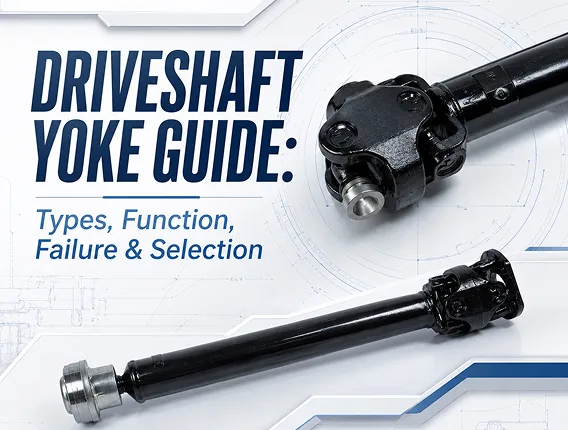

Driveshaft and propshaft are often used interchangeably, especially in everyday conversation and in North America, where both terms typically describe the same long shaft running from the transmission to the rear differential. In British usage, however, the two terms mark a real distinction.
This guide breaks down that distinction from a technical standpoint, covering the differences in design, function, and application so you know exactly how the terms are used in precise engineering contexts.
Table of Contents
What is a Drive Shaft?
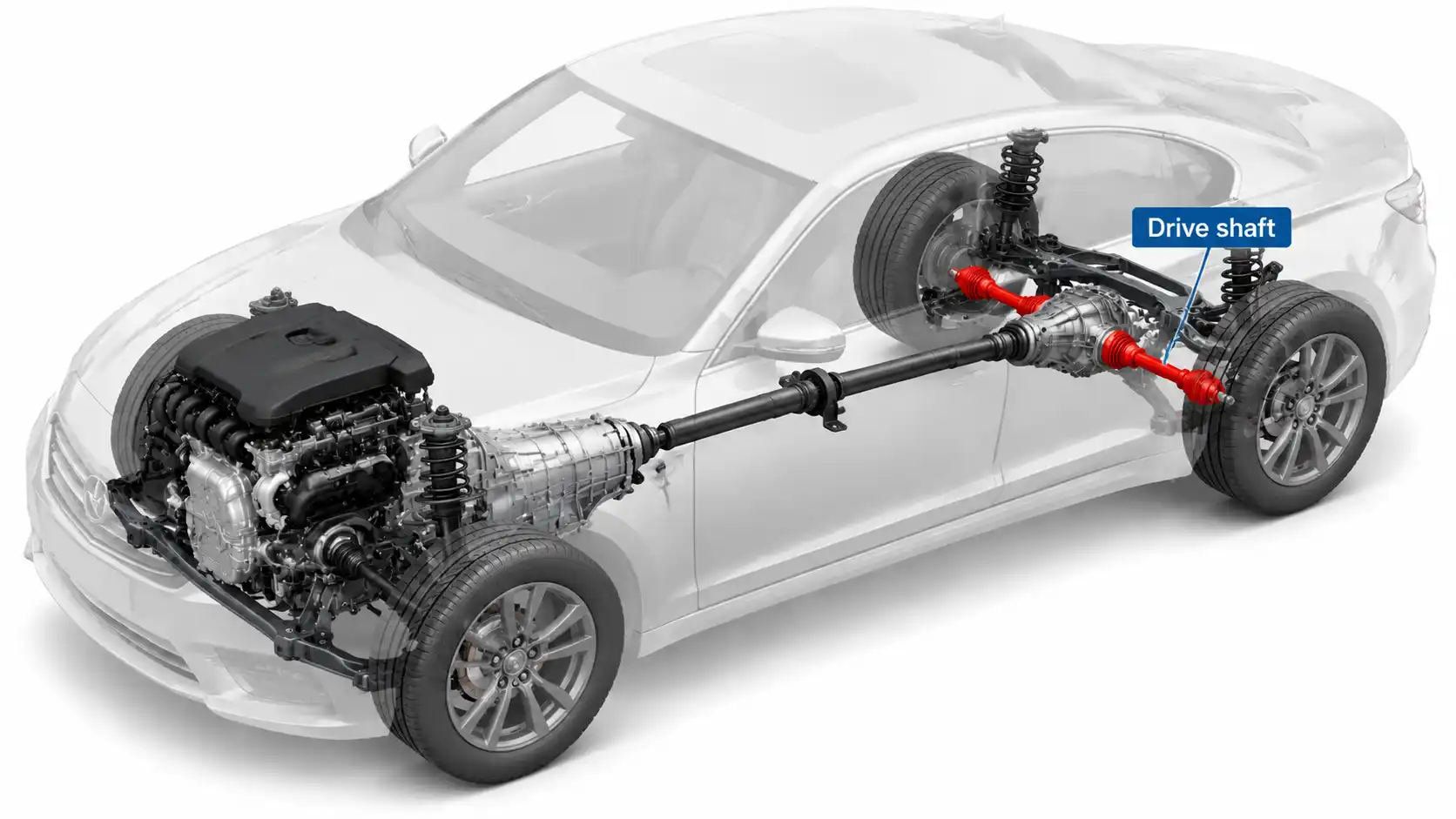
Broadly, and in strict engineering usage, a driveshaft is any rotating shaft that carries power from the transmission or differential to the wheels. Under this definition, a propshaft is technically one type of driveshaft, which is why the two terms often get used interchangeably in casual conversation and in North America.
In British English, however, driveshaft is often used colloquially to refer specifically to the short shaft connecting the differential to the wheel, also called a half-shaft. Under this regional usage, it's treated as a distinct part from the propshaft, serving as the sole power path to the wheels on FWD vehicles and as the rear half-shaft on RWD cars with independent suspension. For the rest of this guide, "driveshaft" is used in this narrower sense.
📚Learn more about drive shaft vs axle shafts in North America:
Drive Shaft vs Axle Shaft: Simple Comparison Guide
What is a Prop Shaft?
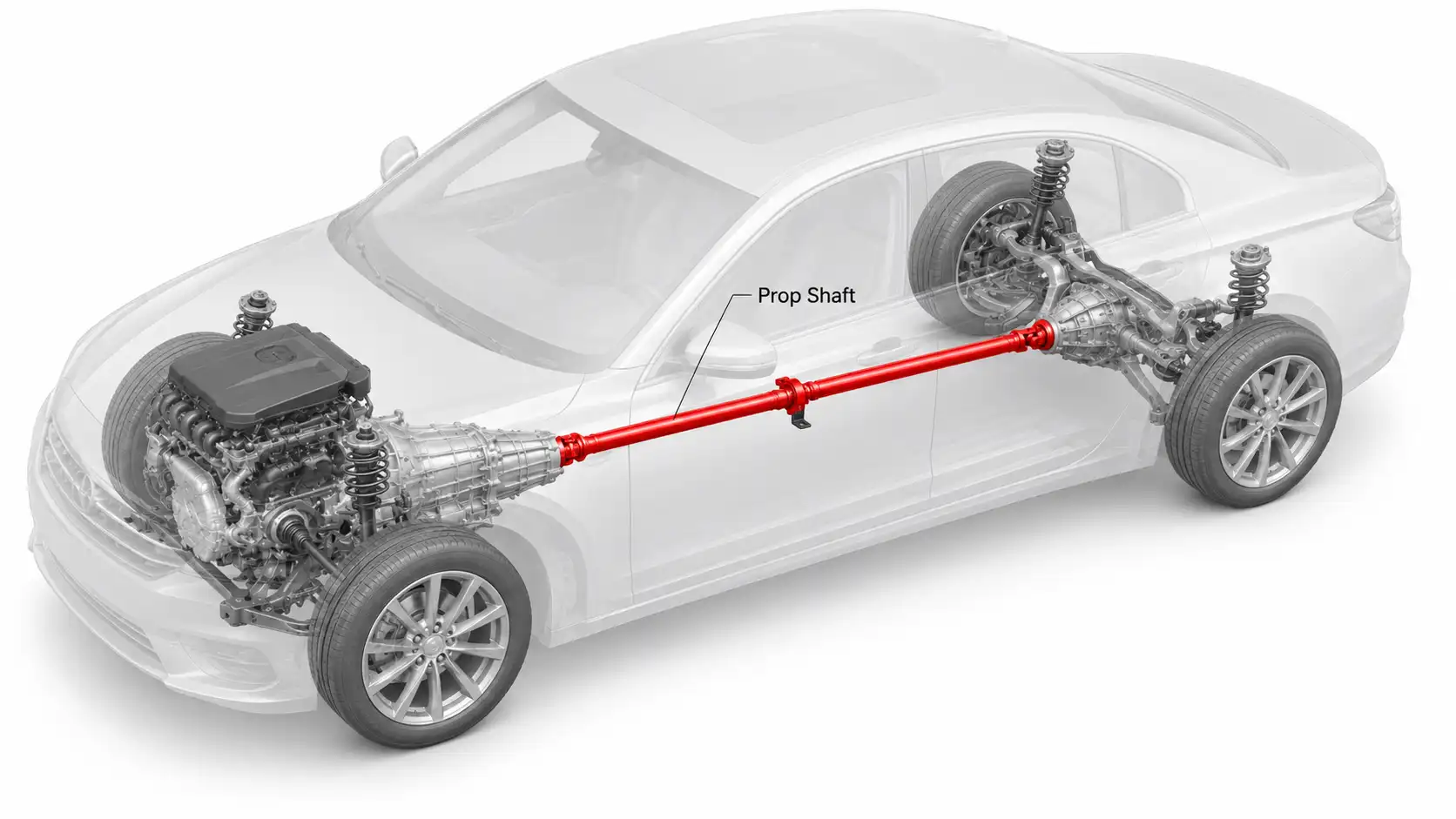
Propshaft, short for propeller shaft, is the long shaft that connects the transmission (or transfer case) to the rear differential. It carries engine power to the rear wheels, making it a core drivetrain part on RWD and 4WD vehicles. The term is more common in British English, while North America usually just says "driveshaft" for the same part. In later sections, we will treat the two separately.
The engine and transmission sit at the front of the vehicle, but the drive wheels are at the rear. That leaves a gap between them, and the distance shifts slightly as the suspension moves. The propshaft's job is to transmit rotational power smoothly across that gap as the drivetrain moves, making it a key link between the front and rear of the drivetrain.
Key Components of Propshafts and Driveshafts
The components used in each shaft reveal how differently they are designed to perform their specific functions. Here's a closer look at what makes up each one.
Propshaft core components:
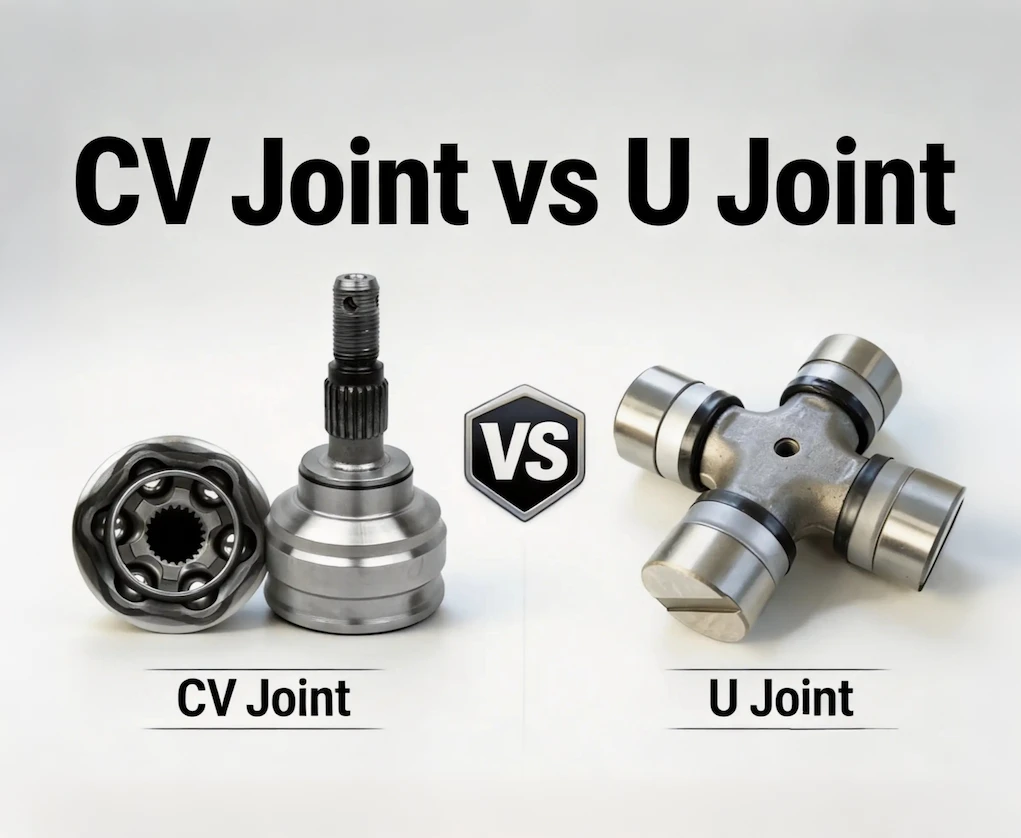
- Universal Joint (U-joint): Located at both ends of the shaft, U-joints allow it to transmit rotational power even when the operating angle changes. They’re also the most common source of wear and noise on a propshaft.
- Slip yoke: Allows the shaft to extend and retract slightly to accommodate changes in length caused by suspension movement.
- Center support bearing: Found only on two-piece propshafts, it supports the middle connection point and cuts down on vibration and noise.
- Flange: A flat, disc-shaped component that connects the propshaft to the transmission output shaft and differential input flange.
Driveshaft (half-shaft) core components:
- CV joints: Located at both ends of the shaft, CV joints maintain constant velocity while transferring power through changing steering and suspension angles. This is the main structural difference from the U-joints on a propshaft.
- CV boot: A rubber or plastic cover around each CV joint that keeps grease in and dirt out. It is one of the most common failure points on a driveshaft.
- Shaft body: The main shaft that connects the inner and outer CV joints and transfers torque from the differential to the wheel hub.
- Circlip: Secures the driveshaft connection to the transmission or wheel hub assembly, preventing the shaft from coming loose.
In short, a propshaft uses U-joints and a slip yoke to handle drivetrain angle and length changes, while a driveshaft relies on CV joints to maintain smooth, constant-velocity power delivery during steering and suspension movement.
If you need a replacement, Zeke Parts carries complete propshaft assemblies, including U-joints, slip yokes, tubing, and flanges. Products are available in standard lengths from 1,500 mm to 3,000 mm, with OEM custom sizing available for less common gearbox-to-differential specifications.
Prop Shaft vs. Drive Shaft: Key Differences
Now that we've covered how each shaft is built, here's a quick table comparing the core differences, followed by a closer look at where each one comes from.
| Comparison | Prop Shaft | Drive Shaft |
|---|---|---|
Joint Type | U-joint | CV joint |
Design | One-piece or two-piece (with center support bearing) | Consistent design: solid shaft with a CV joint and boot at each end |
Power Path | Transmission → rear differential | Differential → wheel |
Vehicle Layout | RWD, 4WD longitudinal drivetrains | FWD, or the rear half-shaft on independent-suspension RWD cars |
Common Examples | Ford F-150, Toyota Hilux | Honda Civic, Volkswagen Golf |
Design
The core reason propshafts stick with U-joints while driveshafts need CV joints comes down to different motion needs. A U-joint is simple and can handle high torque, but it can't maintain constant speed at sharp angles. A CV joint is more complex, but it keeps power delivery smooth through the wide angle changes that come with steering.
The structural layout follows the same logic. Propshafts run the length of a longer chassis, so shorter vehicles typically use a one-piece design, while longer ones often switch to a two-piece design with a center support bearing to cut down on vibration and resonance. Driveshafts cover a much shorter distance, so that issue doesn't come up, which lets the design stay compact and consistent.
Function
Propshafts and driveshafts play different roles in the power delivery chain. A propshaft carries power from the transmission (or transfer case) to the rear differential, while a driveshaft carries power directly from the differential to the wheels.
Together, the two form a complete power path: the engine generates power, the transmission processes it, the propshaft sends it to the rear differential, and the driveshaft splits it between the left and right wheels to drive the vehicle. FWD vehicles rely on driveshafts alone, while RWD and 4WD vehicles use a propshaft and may also use driveshafts at the rear, depending on the suspension.
Application
The difference in application comes down to engine layout. RWD/4WD vehicles with a longitudinal engine have the engine up front and the drive wheels at the rear, so a propshaft is needed to carry power across the length of the vehicle.
FWD vehicles, on the other hand, mount the engine transversely and drive the front wheels directly, so the power path is short. A driveshaft handles this more efficiently and compactly, which is why it's the dominant layout in mainstream family cars today.
Pros and Cons of the Drive Shaft
Like any drivetrain component, a driveshaft has its own strengths and limitations depending on the vehicle design and operating conditions. The main pros and cons include:
Pros:
- High efficiency on pavement: Delivers power directly to the wheels with little energy loss on smooth roads.
- Handles combined angles well: CV joints keep power delivery at a constant speed even through the combined angles of steering and suspension movement.
- Lower vibration risk: Shorter shafts are less likely to develop balance problems.
Cons:
- CV boot vulnerability: The rubber boot protecting each CV joint is prone to cracking, letting grease escape and dirt in.
- Not built for long spans: Without a center support bearing, a driveshaft can’t cover long distances the way a propshaft can.
- Concentrated wear at the wheel end: A failing CV joint puts stress directly on the wheel hub and bearing.
Pros and Cons of the Prop Shaft
A prop shaft’s design makes it suitable for certain drivetrain layouts, but it also comes with trade-offs in terms of complexity and operation. The key pros and cons are listed below:
Pros:
- High torque capacity: U-joints are simple and rugged, built to handle heavy torque loads in trucks and other high-power applications.
- Long-distance torque delivery: Ideal for trucks, buses, and any vehicle with a long wheelbase.
- Factory dynamic balancing: Electronically balanced to run smoothly even at high speeds.
Cons:
- Limited angle capability: U-joints can’t maintain constant velocity at sharp angles the way CV joints can.
- More parts to maintain: U-joints, slip yokes, and center bearings increase upkeep demands.
- Regular lubrication required: Grease fittings need consistent attention to prevent wear.
What Are the Symptoms of a Bad Prop Shaft or Drive Shaft?
Propshaft and driveshaft failure symptoms are often similar. Common signs include vibration while driving, unusual noises during acceleration or shifting, jerky starts or turns, and scraping or clunking sounds from underneath the vehicle.
Beyond these shared symptoms, though, each shaft tends to show its own distinct set of red flags, which can help narrow down the source of the problem:
| Driving Situation | Propshaft Symptoms | Driveshaft Symptoms |
|---|---|---|
During gear shifts (D ↔ R) | Dull clunking sound caused by U-joint or slip yoke play | Usually no obvious symptoms |
During turning or low-speed steering | Usually no obvious symptoms | Clicking or popping sounds, especially during sharp turns |
At higher speeds | Vibration or resonance at a specific speed range | Mild vibration may occur, usually without a clear resonance point |
Visual inspection | Worn center support bearing or sagging shaft | Damaged CV boot with grease leakage |
Common Examples | Ford F-150, Toyota Hilux | Honda Civic, Volkswagen Golf |
Keep in mind that vibration and similar symptoms can also come from unbalanced tires, worn wheel bearings, or other components, so symptoms alone don't always pinpoint the exact source. If you're unsure, it's worth having a professional inspection to confirm the actual cause before replacing any parts.
When to Act?
If you're only noticing occasional, mild noise or a slight vibration, there's usually still time to schedule an inspection, but it's not worth putting off indefinitely. Drivetrain wear tends to accelerate with mileage, and a small issue left alone can turn into a bigger failure, one that costs more to fix and risks damaging nearby parts like the differential or transmission.
If you notice any of the following, though, it's best to stop driving and contact a professional right away:
- Vibration that’s grown noticeably stronger, or is paired with a loud metallic knocking sound
- Sluggish steering response, or unusual resistance felt through the wheel
- Visible bending, cracking, or grease flung heavily off the shaft
- Constant scraping or rattling from underneath the vehicle, along with reduced stability while driving
A shaft that snaps or comes loose entirely can cause a sudden loss of power, or even loss of control. This is a safety issue, not something to push through and hope it holds.
Choosing a reliable replacement prop shaft helps improve durability and reduce the risk of premature failure. Zeke Parts builds its driveline components from high-strength alloy steel tubing for reliable torque handling, with optional corrosion-resistant coating for exposure to water, mud, and other harsh conditions. Reach out with your specs, or request a sample to check the fit before placing a full order.
Contact UsFrequently Asked Questions (FAQ)
Are prop shaft and drive shaft the same?
Not exactly. In casual use, especially in North America, the two terms are often interchangeable. But in British English, a prop shaft connects the transmission to the rear differential on RWD and 4WD vehicles, while a driveshaft is the short shaft connecting the differential to the wheel, most common on FWD cars.
Can you drive with a bad prop shaft?
No, driving with a damaged prop shaft is not recommended. A worn or damaged propshaft can develop excessive play in the U-joints, causing further damage to the differential, transmission, or other drivetrain components. If you notice any warning signs, have it inspected before driving further.
Is replacing a driveshaft a big job?
It's generally a moderate to heavy job. A professional mechanic typically takes 2 to 4 hours, while a DIY repair can take considerably longer depending on experience. The difficulty and cost depend heavily on the vehicle's layout and the extent of the damage.
How much does a prop shaft or drive shaft replacement cost?
Prop shaft or drive shaft replacement costs typically range from $500 to $1,000, including parts and labor for most passenger vehicles. Vehicle make, model, drivetrain type, and part choice all affect the final price. OEM parts often carry a higher price due to brand premiums, while aftermarket suppliers like Zeke Parts offer cost-effective alternatives with OEM-style fit and specifications.
📚Learn more about the replacement cost for prop shaft (referred as drive shaft in North America):
Drive Shaft Replacement Cost: The Complete Guide
Summary
Understanding the difference between a driveshaft and a propshaft helps you identify the correct component, diagnose drivetrain problems more accurately, and make better replacement decisions. Since these terms can vary depending on region and engineering context, knowing how they are used in different applications can prevent confusion during repair or part selection.
For customers looking for reliable drivetrain components, Zeke Parts offers a wide range of driveshaft solutions with the coverage and pricing that make sourcing straightforward. If matching the right component is a challenge for you, Zeke Parts also provides technical guidance to help you find the right drivetrain solution. Your inquiries get a response within 24 hours, so you do not have to wait long.