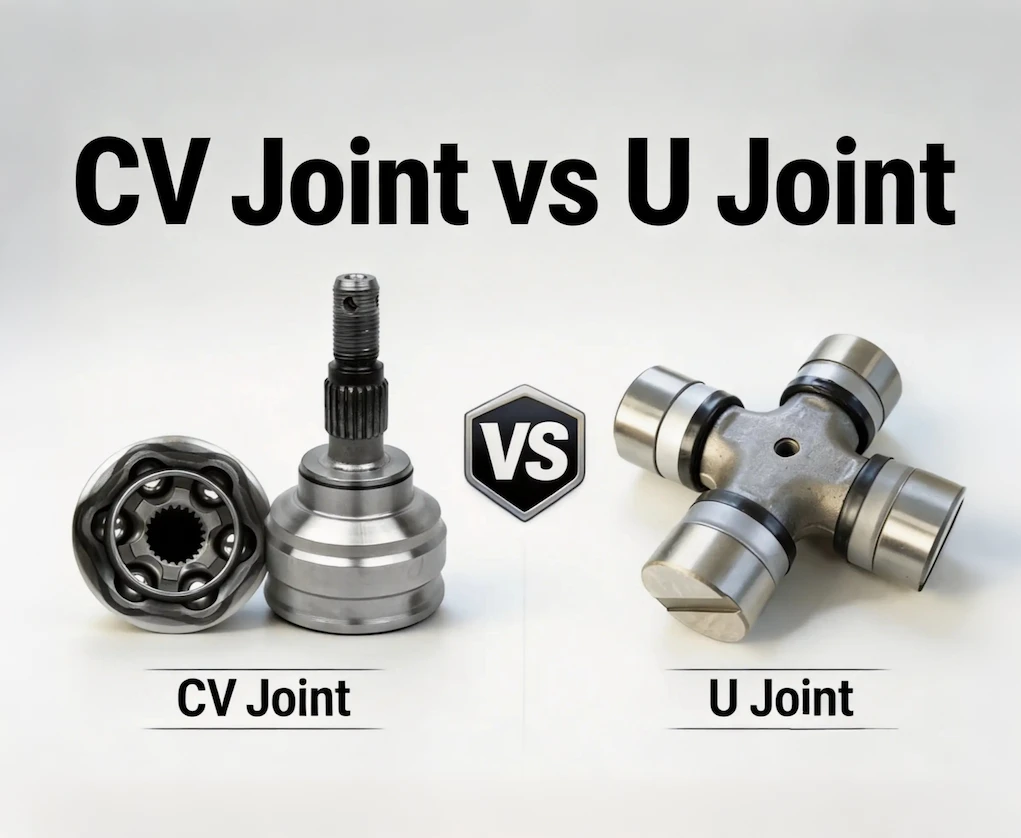

If you’ve noticed a persistent hum at highway speeds or a shudder when accelerating, you’re likely experiencing driveline vibration. A standard U-joint often struggles with the steep angles caused by suspension lifts or long wheelbases. When these angles increase on your double U-joint driveshaft, a single joint creates speed fluctuations and harsh vibrations. The double Cardan joint is specifically engineered to cancel out these inconsistencies, providing a smooth, vibration-free ride. This guide covers how they work, their pros and cons, and how to spot a failing unit.
Table of Contents
What Is a Double Cardan Joint?
A
double Cardan universal joint (double Cardan CV head) is a specialized drivetrain component consisting of two U-joints coupled together by a central centering yoke and a centering ball. Typically mounted at the end of a driveshaft, it is most commonly found on lifted trucks, rugged off-road vehicles, and long-wheelbase rear-wheel-drive cars.
Its primary purpose is to solve the "non-constant velocity" problem of traditional U-joints. Splitting the operating angle between two joints, it eliminates the elliptical speed fluctuations that occur at steep angles, ensuring that power is delivered to the wheels smoothly and consistently.
How Does a Double Cardan Joint Work?
A standard single universal joint has a physical limitation. As the operating angle increases, the output shaft speeds up and slows down twice per revolution. This pulsing is what creates vibration. The double Cardan joint solves this by using a second U-joint to cancel out the first joint's fluctuation. The first U-joint handles the initial angle change, while the internal centering ball ensures both U-joints operate at identical angles. Because the two joints are phased together, the speed fluctuation created by the first is perfectly countered by the second, resulting in a constant output speed.
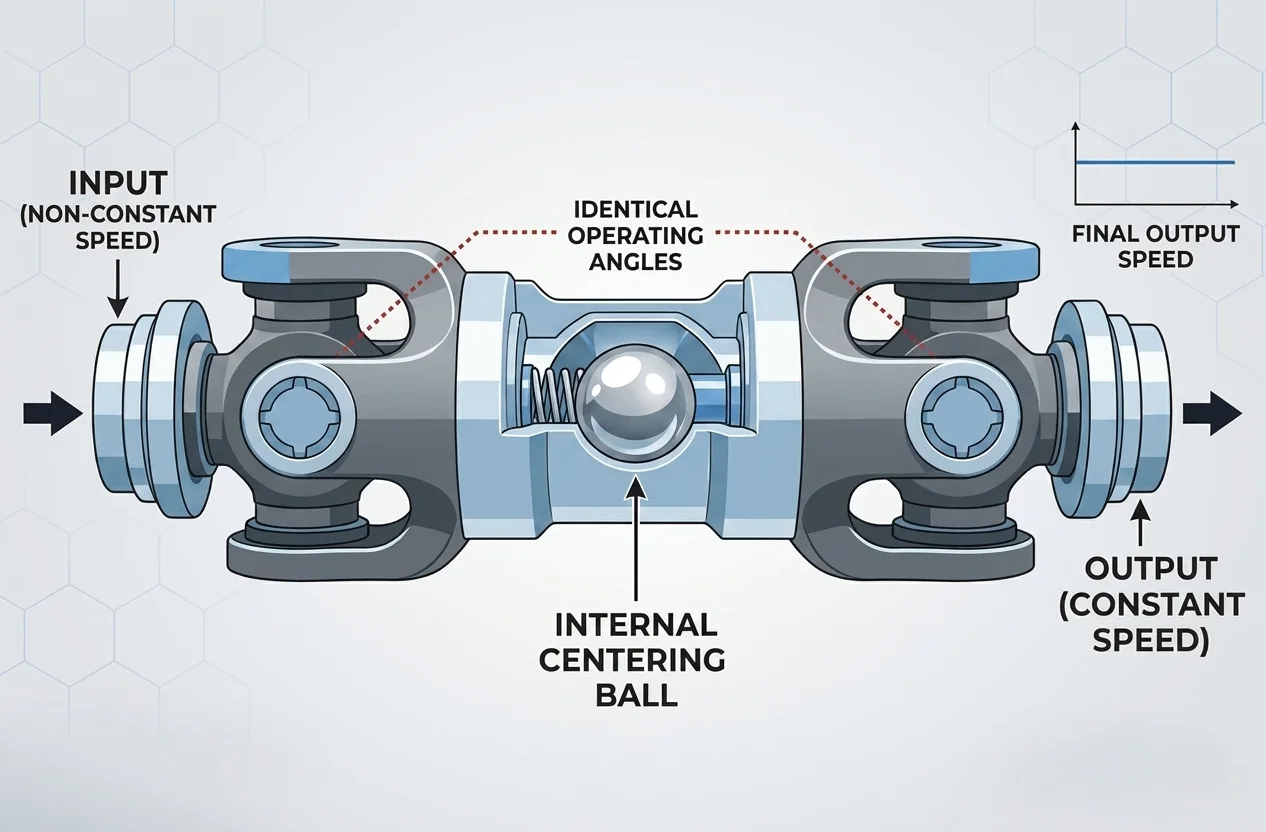
Think of it like a pair of waltz dancers. A single U-joint is like a solo dancer trying to navigate a sharp corner. They might stumble or lose their rhythm. A double Cardan u-joint is like two partners holding hands. When the first person leans left to take the turn, the second person pulls right to provide balance. They support each other in the middle, ensuring the overall path of the dance remains fluid, balanced, and perfectly on beat, no matter how sharp the curve.
Key Components of a Double Cardan Joint
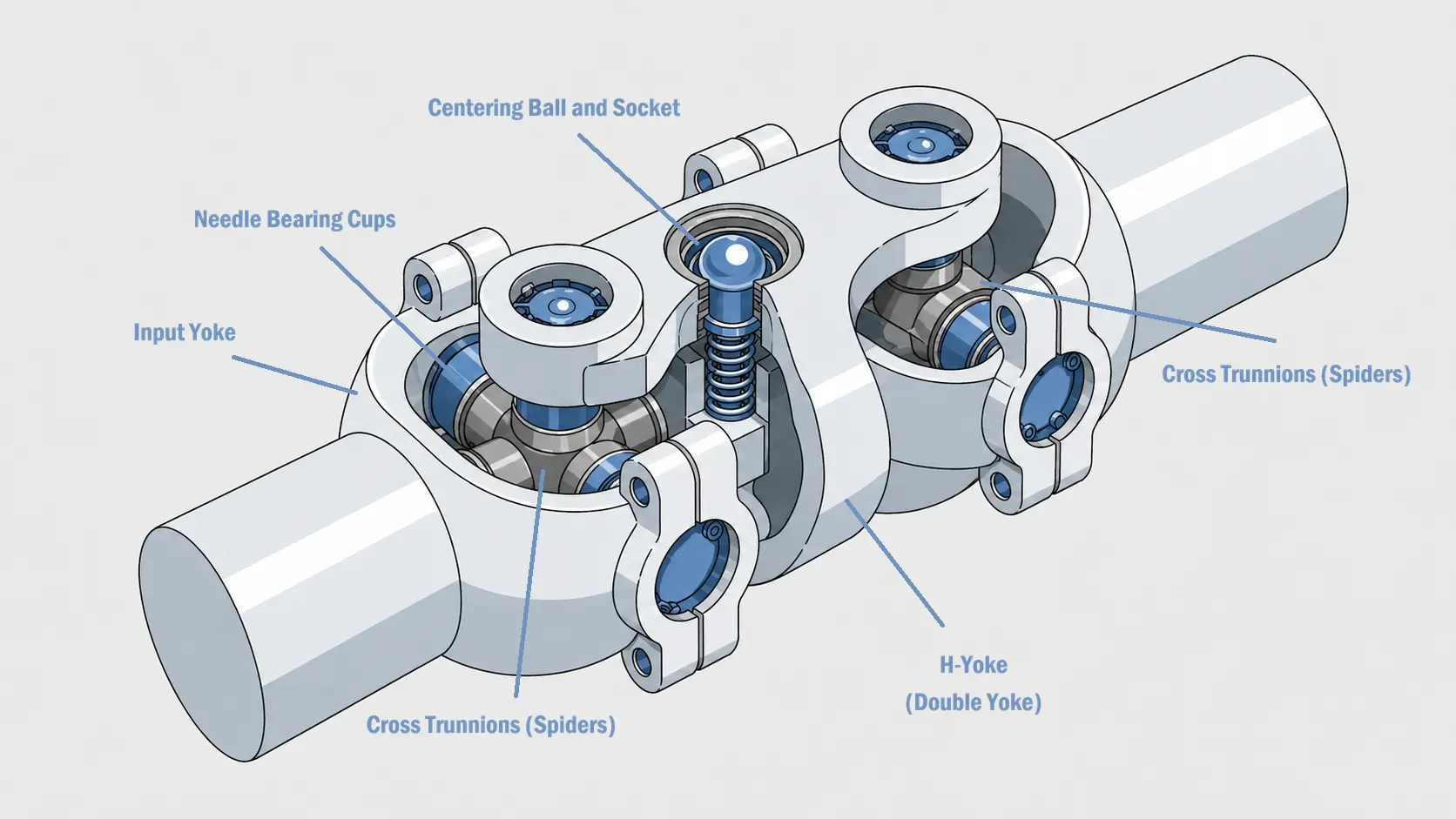
Understanding how this assembly maintains smooth rotation requires a look at its primary components, each playing a vital role in balancing torque and motion:
- Input Yoke: This component connects to the drive shaft and supports the first cross trunnion. The trunnion bearing surface requires a hardness of 58 to 62 HRC and a surface finish of Ra 0.4 μm or better to prevent needle bearings from brinelling after a few thousand cycles.
- H-Yoke (Double Yoke): The short center link between the two Cardan joints. Its lug pairs must be phased at 0° (integrated double Cardan) or 90° (separate end joints). Phasing error > 2° induces second-order vibration.
- Cross Trunnions (Spiders): These are two four-armed crosses, with one per joint, operating on needle bearings inside the yoke ears. For smooth operation, the radial clearance between the trunnion and the bearing must remain under 0.05 mm, as loose bearings will cause clunking when the torque reverses.
- Centering Ball and Socket: Located at the center of the double yoke, this spring-loaded ball nested in a socket forces the intermediate shaft to bisect the input and output angle. Without this mechanism, the joint only achieves constant velocity at one specific operating angle.
- Needle Bearing Cups: These drawn cup needle bearings are packed with EP2 grease and are secured by snap rings or staked into the yoke ears. When operating at angles below 5 degrees, the typical service life on a passenger vehicle prop shaft is between 150,000 and 300,000 km.
Common Applications of Double Cardan Joints
Double Cardan joints are designed to transfer power at steep operating angles while eliminating vibrations. They are frequently utilized in vehicles where suspension geometry or driveline layouts create challenging angles between components.
- Jeep Series Models: Commonly used in models such as the Jeep Wrangler, Cherokee, CJ, TJ, and XJ to eliminate severe driveline vibrations caused by changing the suspension height.
- Mid-size Trucks and SUVs: Includes the Toyota Tacoma and Toyota 4Runner. These vehicles often utilize standard U-joint layouts from the factory. However, they frequently integrate double Cardan shafts in specific versions or after suspension modifications to address vibration.
- Heavy-duty Trucks and Pickups: Covering models such as the Ford Ranger, F-250, and F-350, these trucks primarily use standard U-joints. They incorporate double Cardan designs when required to handle larger operating angles, suspension lifts, or specific driveline configurations.
- Heavy Machinery and Industrial Equipment: Utilized in equipment such as the Volvo A40G articulated dump truck to absorb steering articulation and pitch oscillation during movement. They are also standard in heavy industrial applications like steel rolling mills and continuous casters, where work rolls move vertically.
- Marine Applications: Frequently used in inboard boats and cruisers to smoothly link forward-mounted engines to stern-located V-drive systems, bridging the steep angles between components.
Double Cardan Joint Series by Vehicle Type
Selecting the right series is essential for ensuring drivetrain durability, particularly when modifying a vehicle for increased power or suspension height. These joints are categorised based on their size, torque capacity, and intended application. The following breakdown outlines the typical applications and common vehicle fitments for each series:
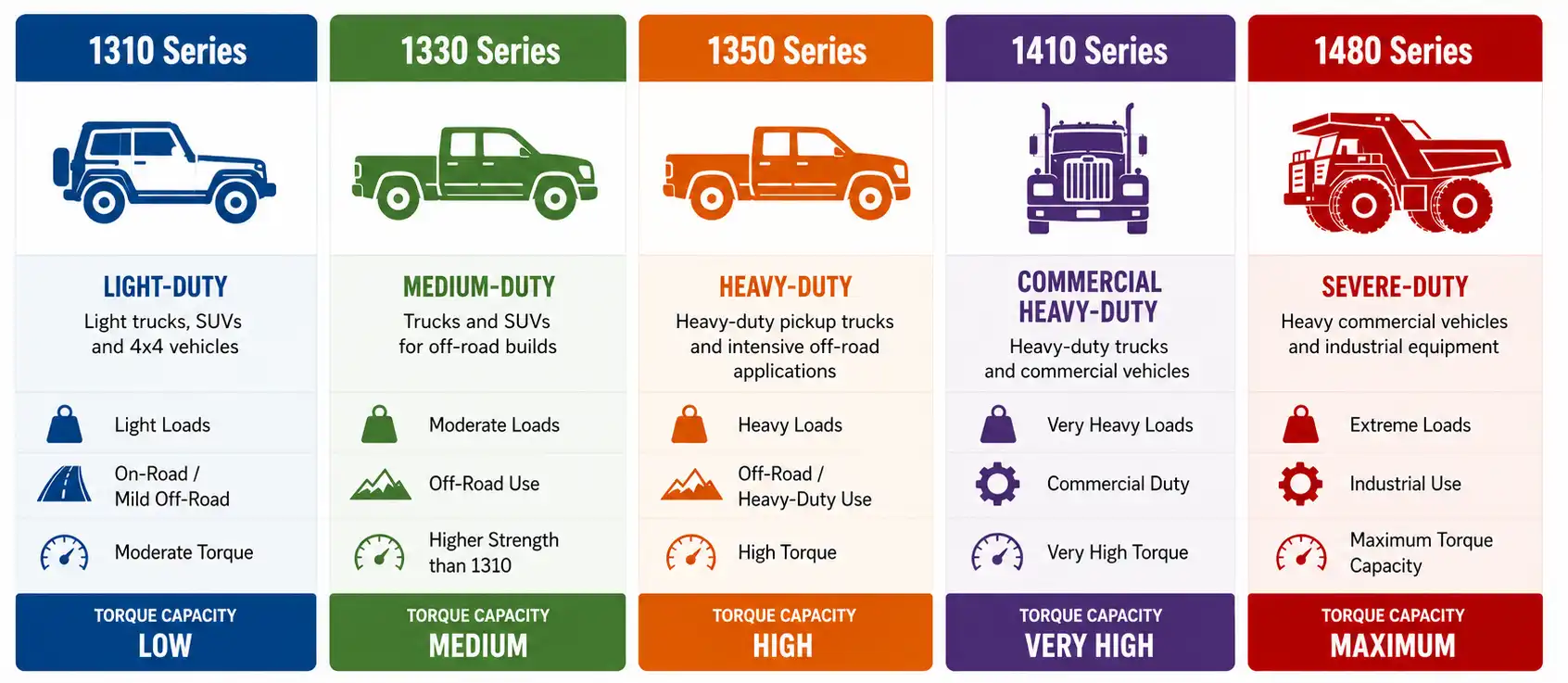
- 1310 Series: These are utilized for light-duty trucks, SUVs, and 4×4 vehicles. Common applications include the front axle setups on Jeep Wrangler TJ and JK, as well as select Toyota Tacoma, 4Runner, and Ford Ranger models.
- 1330 Series: This series is designed for medium-duty trucks, SUVs, and off-road builds. It is frequently found in upgraded driveshafts for Jeep models, alongside specific Toyota Tacoma, 4Runner, and Ford light-to-medium duty 4×4 trucks.
- 1350 Series: Engineered for heavy-duty pickup trucks and intensive off-road applications, this series provides the necessary strength for high-torque demands. Typical applications include Ford F-series trucks, heavily lifted Jeeps, and various full-size 4×4 trucks.
- 1410 Series: These are intended for heavier truck, industrial, and high-torque drivetrain configurations. They are commonly seen in heavy-duty trucks, specific high-torque Ford configurations, and industrial drivetrain projects.
- 1480 Series: Specialized for extreme heavy-duty and high-torque industrial use, this series is rarely seen in mainstream passenger vehicles. They are typically applied in heavy commercial vehicles, industrial equipment, and custom high-torque drivetrain assemblies.
Double Cardan Joint vs. Single Cardan Joint
So how do these two designs compare? A single Cardan joint (the standard U-joint) is simple, cheap, and reliable under factory conditions with mild operating angles. A double Cardanjoint is more complex and expensive, but it shines when suspension lifts, larger tires, or steep driveline angles come into play. The table below summarizes the key differences between the two designs.
| Feature | Single Cardan Joint | Double Cardan Joint |
|---|---|---|
Structure | Single U-joint cross | Two U-joints + Centering Ball |
Velocity | Non-constant (pulsating) | Near-constant (self-canceling) |
Operating Angle | Best under 3°; poor above 5° | Handles 5° to 30°+ smoothly |
Vibration Level | High at steep angles | Smooth and low noise |
Maintenance | Low (many sealed units are maintenance-free) | High (centering ball requires regular greasing) |
Installation & Tuning | Simple; needs precise alignment | Complex; requires equal angles + correct phasing; improper install causes worse vibration |
Best Fit | Stock-height daily drivers, low-angle industrial shafts | Lifted 4x4s, off-road vehicles, PTO drives, articulated machinery |
Benefits & Limitations of a Double Cardan Joint
Upgrading to a double Cardan joint brings several tangible improvements over a standard U-joint, especially for vehicles with modified suspension or aggressive drivetrain geometry. However, it also comes with drawbacks that may make it unsuitable for certain applications. Here's a balanced look at both sides.
Benefits:
- Near-Constant Velocity: It effectively eliminates the “fast-slow” pulsing common in standard joints, providing a much smoother delivery of torque.
- Handles Extreme Angles: It is designed for high-stress geometry. While a standard joint struggles beyond just a few degrees, a double Cardan can handle steep angles (typically 15° to 30° or more) found on lifted 4x4s. For heavy-duty builds, a 1350 double Cardan joint offers significantly higher strength margins than a 1310, making it ideal for oversized tires.
- Reduced Noise and Vibration: By normalizing rotational speed, it drastically reduces mechanical chatter and “driveline growl,” protecting your transmission and differential bearings from premature wear.
Limitations:
- Higher Cost: Due to its complex design involving two U-joints and a centering assembly, it is significantly more expensive than a simple single joint.
- Frequent Maintenance: The centering mechanism is a wear item and should be greased regularly, though access to the fitting may be limited depending on the design. If the wear is too significant, you may need a specialized double Cardan joint rebuild kit to restore performance.
- Space Constraints: These joints are physically longer and wider than standard joints, which can lead to clearance issues in tight chassis tunnels.
- Balance Sensitivity: Double Cardan joints are sensitive to imbalance and improper driveline setup, which can lead to vibration at higher speeds.
- Specific Geometry Requirements: To work correctly, the pinion angle should usually be set to point toward the transfer case output shaft. This often requires adjustable control arms or leaf spring shims.
How to Tell If Your Double Cardan Joint Is Failing?
Every vehicle part has a limited life, but the signs of a failing double Cardan joint are hard to miss. Your vehicle will usually give you clear warnings before a complete failure:
- High-Speed Vibration. A rhythmic shaking that intensifies as you accelerate. Unlike standard U-joint issues, this vibration often feels torque-sensitive, running smoothly under light throttle but turning harsh when you step on the gas or let off.
- Low-Speed Chirping or Squeaking. A high-pitched bird-chirping sound or squeaking sound at 5–15 km/h, especially when releasing the brakes, often points to a dry or worn centering ball. This noise is distinctly sharper than the deep thunk of a failing standard U-joint.
- Clunking When Shifting. A loud clunk or sloppy engagement when shifting from Park to Drive or Reverse is common in trucks with two-piece driveshafts.
- Grease Splatter or Rust Dust. Finding a ring of fresh grease on the underside of the vehicle directly above the joint, or fine brown rust powder around the bearing cups, indicates the centering ball seal has failed and dirt has entered the assembly.
- Shuddering at Low-Speed Acceleration. A sensation like driving over washboards on a perfectly smooth road at 5–20 km/h means the centering ball is worn, causing uneven angles between shaft segments.
If you notice any of these warning signs, replace the bad double Cardan joint immediately. A failed double Cardan joint can lead to a catastrophic driveshaft failure, potentially damaging your transfer case or differential and turning a low-cost fix into an expensive repair.
Where to Buy Quality Double Cardan Joints
When it comes to reliability, Zeke Parts is a top-tier choice. The company manufactures double Cardan joints using high-strength forged alloy steel and precision machining to ensure minimal runout, which helps reduce vibration and noise. Their products follow strict OEM technical specifications, offering 100% physical compatibility without the steep brand markup.
Zeke Parts provides extensive coverage for mainstream brands, with specialized Toyota double Cardan joints for models like the Tacoma available as direct bolt-on replacements. OE-branded options from Spicer, SKF, and Neapco are also in stock, catering to everything from factory-original builds to custom off-road rigs. Popular U-joint series such as 1310, 1350, and 1410 are all represented, making it easy to find the right match for nearly any application.
Beyond double Cardan joint replacements, Zeke Parts also specialize in building custom driveshafts for any application. Whether you need a specific length or a unique angle configuration, their team can engineer a solution to match your vehicle's exact requirements. Meanwhile, shipping is available worldwide, and technical support is readily available to help you determine the right fit for your lift kit or any modification. Questions are always welcome.
Contact UsFrequently Asked Questions (FAQ)
How does the ball joint go together on a double Cardan joint?
The centering ball sits in a socket between the two U-joints. It usually features a spring-loaded or floating design that forces the two joints to split the angle equally. During assembly, the ball must be seated perfectly into the socket to allow the yoke to pivot smoothly.
Is a double Cardan joint better for off-road?
Absolutely. Because off-roading often involves lifted suspensions and high axle articulation, the angles are too steep for a single U-joint. A double Cardan can handle operating angles up to 30° without vibrating or binding.
How do I know which double Cardan joint fits my vehicle?
To find the correct fitment, you need your vehicle’s year, make, and model, along with any lift kit specifications. Additionally, performing a precise u-joint identification is essential; you should measure the bearing cap diameter and the overall width of the joint (lock ring to lock ring) to ensure it matches common series like 1310 or 1350.
Is a double Cardan joint classified as a constant-velocity joint?
No. It is a "near-constant-velocity" joint. While it approximates CV performance by canceling out fluctuations, it is technically not a true CV joint like the Rzeppa joints found in front-wheel-drive axles.
📚Related Reading: Universal Joint Types Explained: Comparison & Key Applications
Conclusion
The double Cardan joint is a mechanical marvel that solves the biggest headache for truck and 4x4 owners: driveline vibration. By using a dual U-joint and centering ball design, it tames steep angles and delivers smooth power. While it requires more maintenance than a standard joint, the trade-off in ride quality and component longevity is well worth it. If your vehicle is shivering at speed, don't wait for a breakdown. Visit Zeke Parts today to browse the high-performance selection or contact the support team to confirm the perfect fitment for your build.