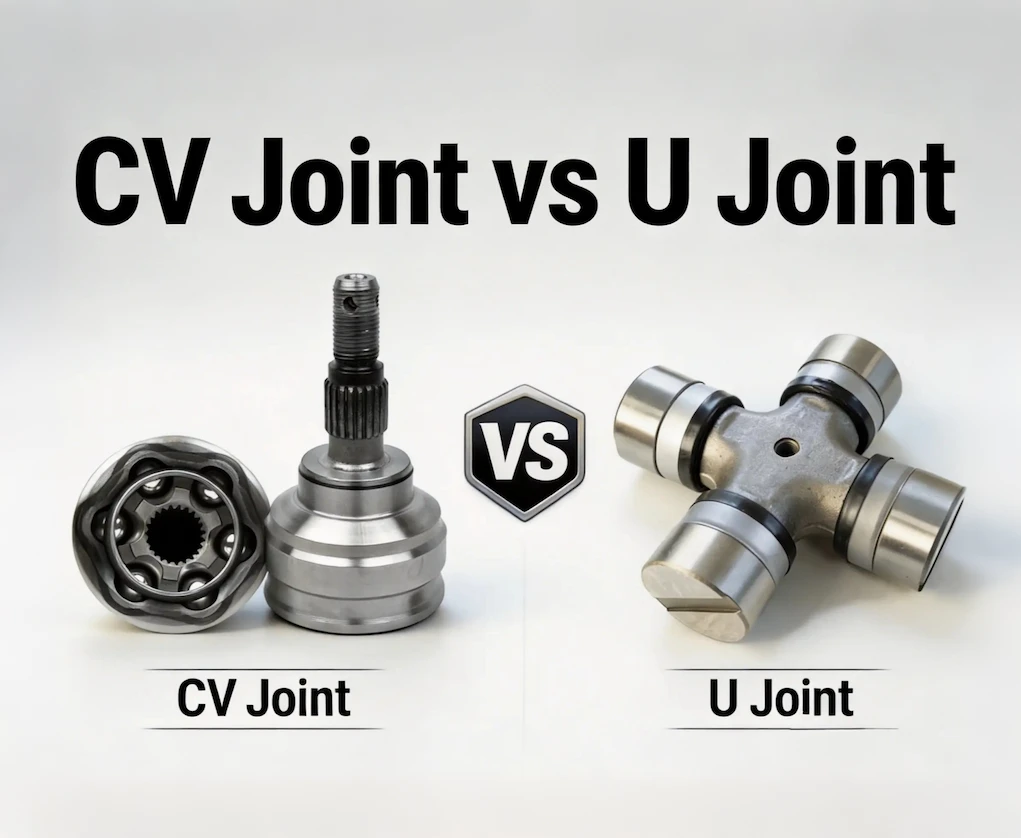

When replacing or custom-building a driveshaft, getting the correct length is critical. A driveshaft that is too long can damage your transfer case or transmission, while one that is too short may cause insufficient spline engagement or even disconnection during operation.
This is especially important if you have lifted your vehicle, swapped axles, or modified your drivetrain, situations where factory dimensions no longer apply.
Although measuring driveshaft length is not inherently complicated, different connection types require different reference points and measurement methods. This guide provides the tools required, measurement methods for end yoke, slip yoke, reverse slip, and flange connections, as well as common errors and supplementary data needed when specifying a custom driveshaft.
Table of Contents
Tools Required for Drive Shaft Measurement
Before taking any measurements, identify your connection type. Whether your vehicle uses an end yoke, slip yoke, reverse slip, or flange connection will determine how you measure the driveshaft.
Once that is clear, prepare your tools. Having everything ready beforehand will help you work more efficiently and reduce the chance of recording incorrect data.
Required tools:
- Tape measure: A steel tape measure that is at least 60 inches (150 cm) long is recommended. Cloth tapes are not suitable because they tend to stretch.
- Angle finder: A digital angle finder provides the most accurate readings, but you can also use a smartphone app or an analog tool.
- Marker: Useful for marking splines and reference points during measurement.
- Paper and pen: You should always record your measurements as you go. A quick sketch can help prevent confusion later.
Optional tools:
- Straight pipe or string: This tool helps simulate the driveshaft centerline when the shaft has been removed.
- Bungee cord: Use it to keep your simulated line in place.
- Caliper: A caliper allows you to measure U-joint caps and flange pilot diameters precisely.
- Jack and wood blocks: If you do not have access to a lift, these items are necessary to keep your vehicle at ride height.
Before you begin, double-check that the vehicle is sitting at normal loaded ride height. Measuring with the suspension hanging will produce inaccurate results.
Drive Shaft Length Measurement for End Yoke Connections
An end yoke is one of the most common connection types you will encounter. It is part of the driveshaft. And it attaches with a U-joint to the output shaft of the transmission, transfer case, or differential. This connection type is widely used in rear-wheel drive (RWD) vehicles, four-wheel drive (4WD) vehicles, pickup trucks, SUVs, and many light-duty and heavy-duty commercial vehicles.
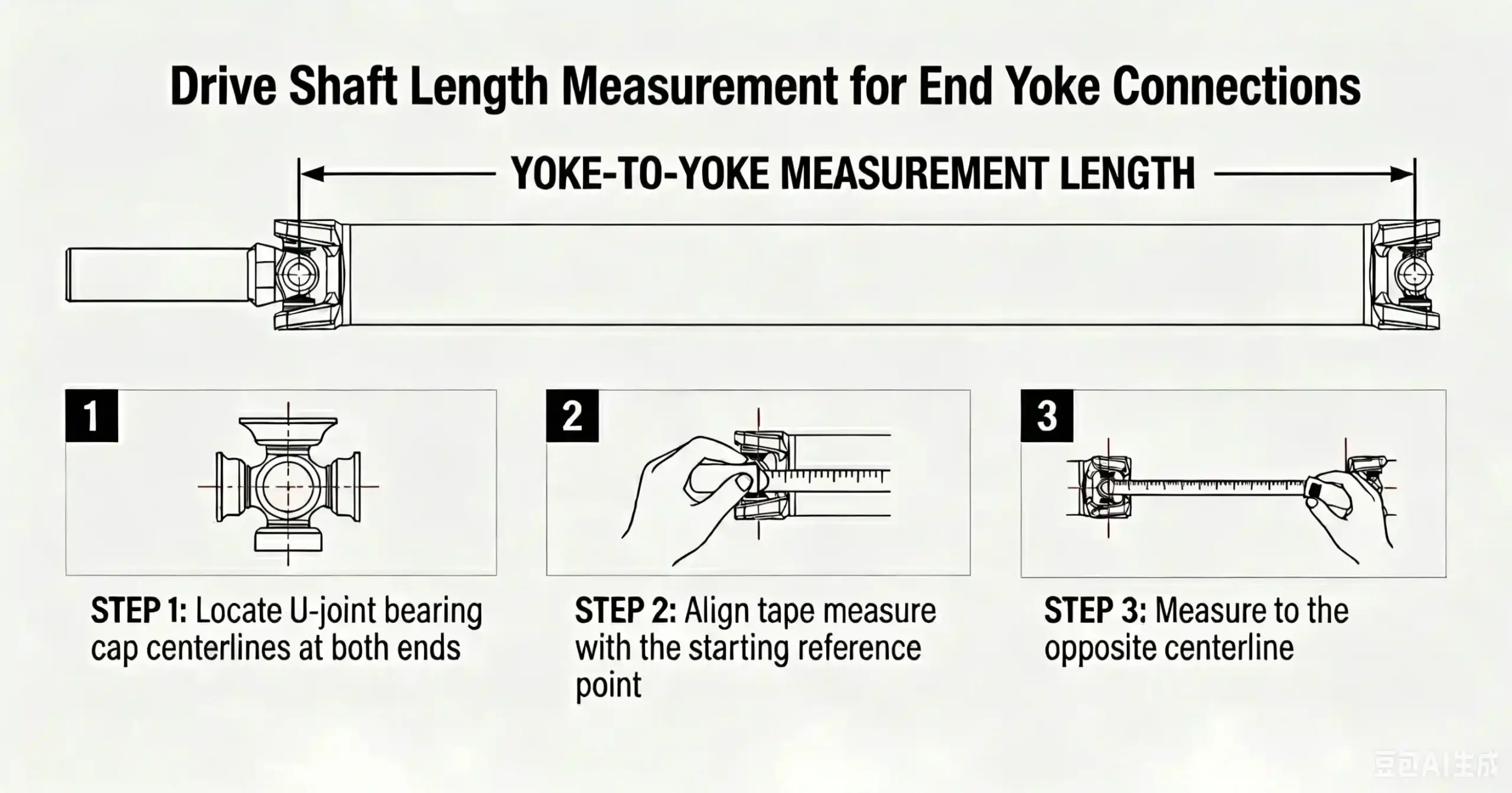
To get the correct driveshaft length for an end yoke connection, just follow these steps:
Step 1: Locate the U-joint bearing cap centerlines at both ends
Find the centerline of the U-joint bearing cap on the transmission side and again on the differential side.
Step 2: Align your tape measure with the starting reference point
Place the end of your tape measure at the centerline of one bearing cap. In practice, you can often use the edge of the yoke as a reference because it aligns with the centerline.
Step 3: Measure the opposite centerline
Extend the tape to the centerline of the other U-joint bearing cap. Record the distance between the two centerlines. This is your yoke-to-yoke measurement length.
Knowing where to measure is only part of the process. Even experienced mechanics occasionally use the wrong reference point. Here is what to watch out for:
- Placing the tape against a fixed nut.
- Measuring the threaded end of the output shaft.
- Using the very tip of the output shaft as the reference.
Always measure to the U-joint bearing cap centerline, not to the nut, thread, or shaft end.
Drive Shaft Length Measurement for Slip Yoke and Reverse Slip Connections
A slip yoke is a widely used telescoping design. It allows the driveshaft to shorten when the suspension compresses and lengthen when it extends. A reverse slip yoke mounts the slip section on the transfer case side. You will find this design on many four-wheel-drive vehicles with a transfer case, such as the Jeep Wrangler, Toyota FJ Cruiser, Toyota Prado, Mitsubishi Pajero, and several off-road SUVs.
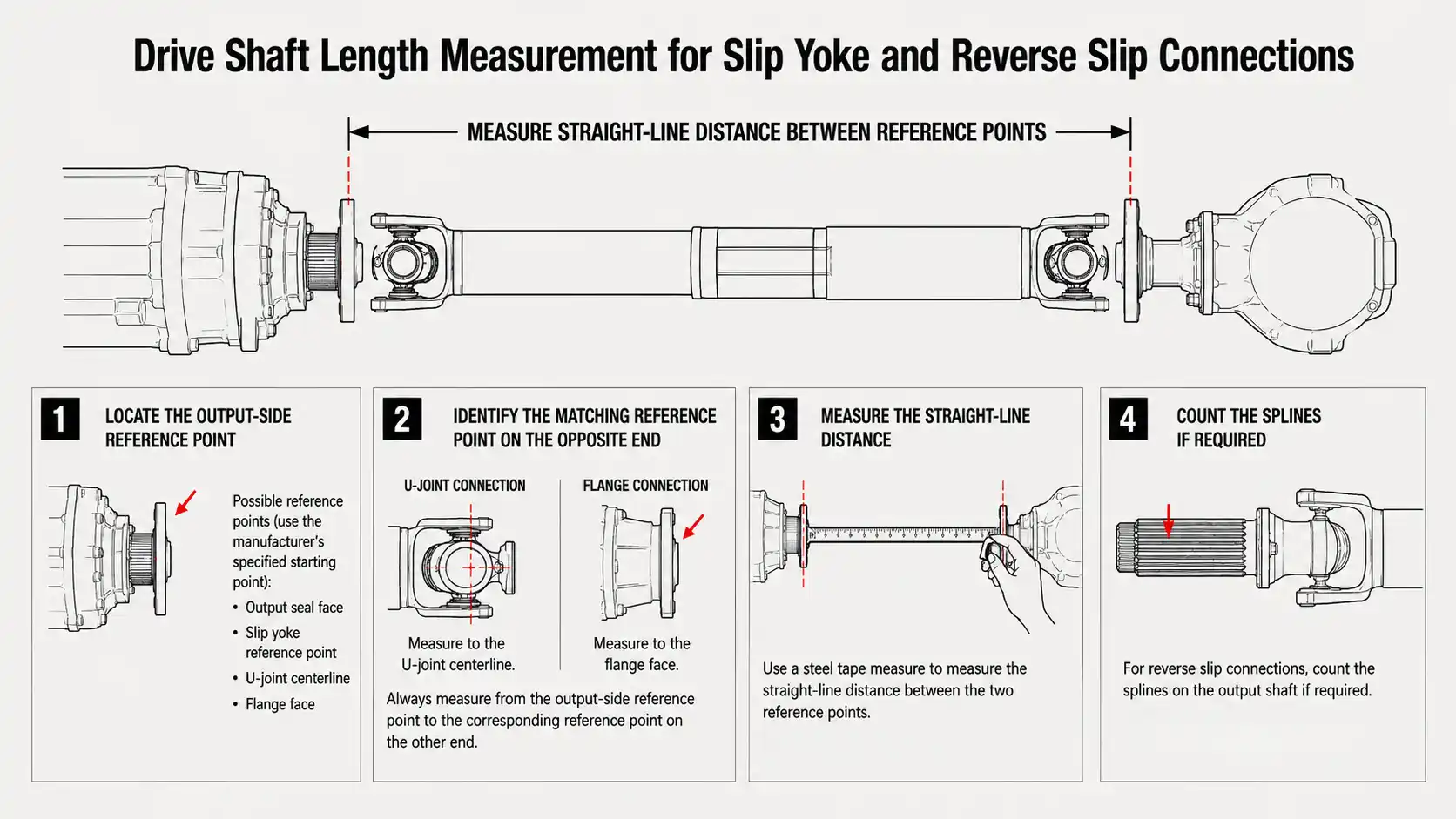
Getting an accurate length for these setups requires attention to vehicle position and reference points. Follow these 4 steps in order:
Step 1: Locate the output-side reference point
Start at the transmission or transfer case output side. Identify the correct reference point based on the connection type, such as the output seal face, slip yoke reference point, U-joint centerline, or flange face. Always use the manufacturer's specified starting point.
Step 2: Identify the matching reference point on the opposite end
Next, look at the differential side and determine which reference point applies there. If the rear connection uses a U-joint, the measurement should go to the U-joint centerline. If the connection uses a flange, the measurement should go to the flange face. In other words, you are always measuring from the output-side reference point to the corresponding reference point on the other end.
Step 3: Measure the straight-line distance
Use a steel tape measure. Measure the straight-line distance between the two reference points. Make sure the tape is straight, and record the result carefully. This is the length for ordering or building the driveshaft.
Step 4: Count the splines if required
For reverse-slip connections, some manufacturers also ask for the spline count of the output shaft. Mark one spline with a marker as a starting point, then count carefully to avoid missing or double-counting.
Stock measurement guidelines assume a factory setup. If your vehicle has been altered, you need to account for those changes. Pay attention to these 2 points:
- If your vehicle has a lift kit or suspension modification, measure at the actual ride height after the modifications are complete.
- For high-flex off-road vehicles, also record the compressed and extended suspension measurements to ensure sufficient slip travel.
Drive Shaft Length Measurement for Flange Connections
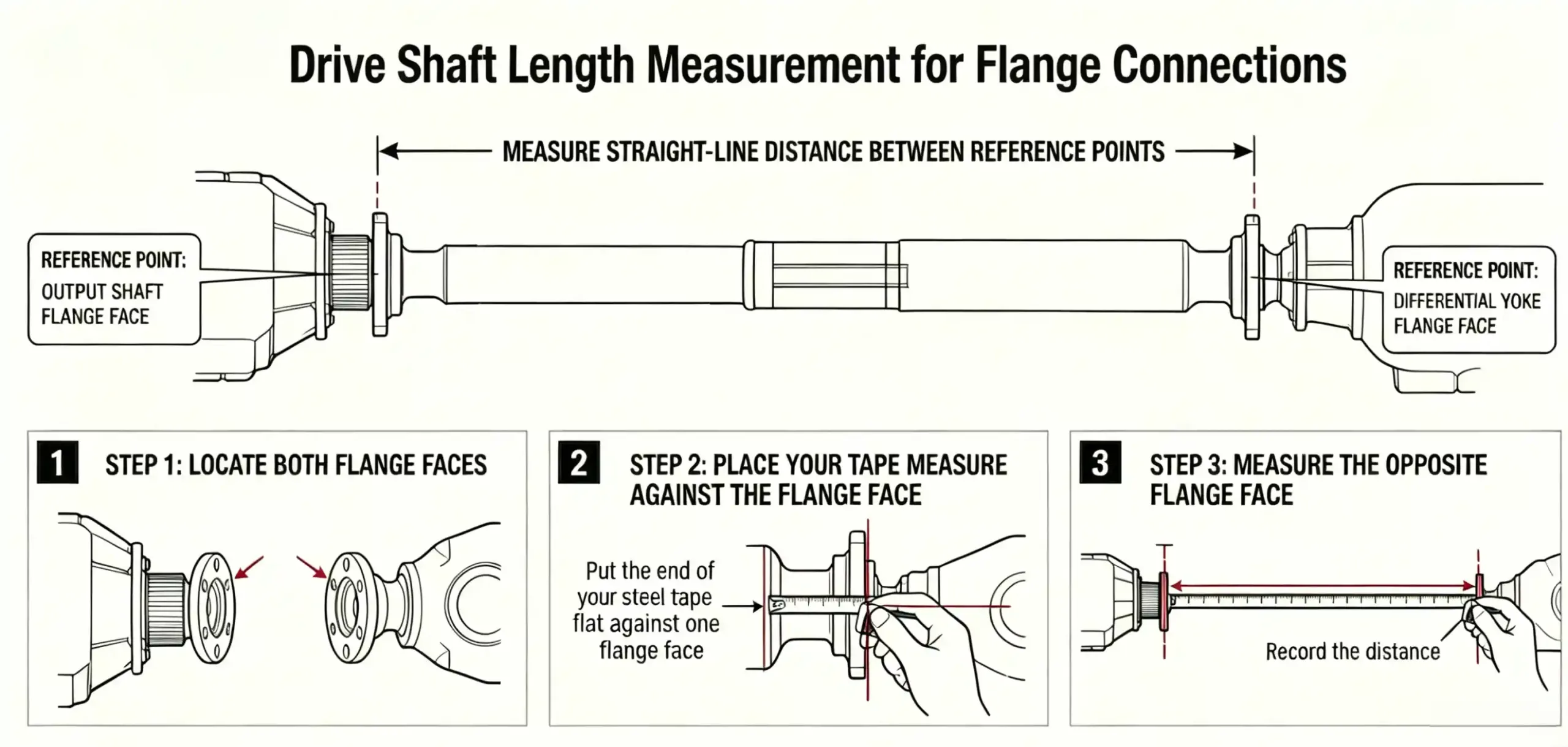
A flat flange connects the driveshaft directly to the transmission, transfer case, or differential using bolts. You will commonly see flange connections on independent rear suspension (IRS) vehicles and many heavy-duty trucks.
Measuring flange connections is straightforward, but you need to know exactly which surface counts as the reference point. Follow these 3 steps:
Step 1: Locate both flange faces
Identify the actual machined surfaces where the driveshaft flange bolts to the mating flange on the transmission and differential.
Step 2: Place your tape measure against the flange face
Put the end of your steel tape flat against one flange face. Do not measure to the outer edge of the flange, a bolt head, or a pilot boss.
Step 3: Measure the opposite flange face
Extend the tape in a straight line to the other flange face. Record the distance.
💡Tip: Clean oil, dirt, and rust off both flange faces before measuring. This reduces error.
Flange measurement differs distinctly from end yoke connection measurement due to different reference points. These varying reference points rule out a universal measuring procedure for the two connection styles. Incorrect referencing commonly leads to improperly sized custom driveshafts.
Below outlines the specific measuring criteria for each configuration:
- End Yoke connection: Measures from U-joint bearing cap centerline to opposite U-joint bearing cap centerline.
- Flange connection: Measures from flange face to mating flange face.
How to Measure Drive Shaft Length When the Yoke Is Missing
Sometimes the original driveshaft has already been removed, or the yoke is lost or damaged. When you cannot use the standard direct measurement method, you have 3 alternatives.
Method 1: Simulate the Centerline
First, ensure the transfer case and differential are installed in the vehicle, and the vehicle is at full ride height. Then use a straight pipe, a taut line, or a bungee cord to simulate the driveshaft centerline. Run this line from the transfer case output shaft to the differential reference point. Measure that straight-line distance.
Method 2: Consult the Manufacturer
Many professional driveshaft manufacturers provide online driveshaft length calculators, measurement guides, or specification sheets. By supplying your transfer case model, differential model, and the mounting distance between them, you can often get a reliable length estimate.
However, for lifted vehicles, axle-swapped builds, or when the original shaft is completely missing, an online tool alone may not be sufficient. In these cases, contacting the manufacturer directly for confirmation is more reliable. Zeke Parts offers technical support to verify your measurements, confirm connection types, and recommend the right product. You can typically expect a reply within 24 hours.
Method 3: Install a Yoke First
If possible, buy or borrow the correct yokes for your transfer case and differential. Install them, then measure them using the standard yoke-to-yoke method described earlier. This is the most accurate approach.
Common Drive Shaft Measurement Mistakes
Even small errors can lead to major fitment issues. The most common mistakes include:
- Measuring with the vehicle off the ground. When the suspension is hanging on a lift, your measurement will be too long. After the vehicle is back on the ground, the suspension compresses, and the actual required length is shorter. This can cause the new shaft to bottom out and damage the transfer case.
- Measuring to a nut or shaft end instead of the bearing cap centerline. This mistake typically shortens your measurement by 1–2 cm. As a result, the yoke may pull out of the transmission during driving.
- Forgetting to count splines on a reverse slip connection. If the spline count is wrong, the new driveshaft will not insert at all.
- Measuring flange bolt spacing in only one direction. Many flanges use a rectangular bolt pattern, meaning the X and Y distances are different. Measuring only one direction leads to bolts that do not line up.
- Failing to record angle data when ordering a CV driveshaft. Double-cardan (CV) driveshafts are highly sensitive to angles. If you provide only length without angles, the manufacturer cannot build a product that will work correctly.
Avoiding these common mistakes can help ensure a proper fit and prevent costly installation issues.
Additional Measurements That May Be Required for a Custom Driveshaft
While driveshaft length is the primary measurement, it is not always enough for custom, modified, or CV driveshaft applications. Additional dimensions are often required to ensure proper fitment and performance. Many driveshaft manufacturers request the following extra data.
- U-joint specifications (for end yoke connections)
- Spicer-style end yoke: The bearing cup has a locating boss. You need the distance between the two bosses (U-joint overall width) and the bearing cap diameter.
- Saginaw-style end yoke: No locating boss; uses retaining clips instead. Measure the distance between the two yoke ears (between the clip grooves) and the bearing cap diameter.
- Flange dimensions (for flange connections)
- Pilot diameter: The diameter of the centering boss or recess in the middle of the flange.
- Bolt pattern: Measure the center-to-center distance in both the X and Y directions. Most flanges are rectangular, so these two dimensions differ.
- Driveshaft angles (required when ordering a CV driveshaft)
- Transfer case angle: Place your angle finder flat against the flange face for flange connections, or across the two flat sides of the yoke for end yoke connections.
- Driveshaft angle: If the driveshaft is already removed, simulate the centerline with a straight pipe, taut line, or bungee cord, then measure.
- Differential angle: Place the angle finder between two bolts on the differential cover.
The additional measurements you need depend on your vehicle configuration and the type of driveshaft you order. Preparing this information in advance helps the manufacturer match the correct product and reduces installation problems.
If you need a custom driveshaft or are unsure which data to provide, Zeke Parts offers technical support and custom manufacturing. Our standard-size driveshafts cover lengths from 1500 mm to 3000 mm, and we also provide OEM-style custom shafts based on your actual gearbox/transfer case-to-differential mounting dimensions.
Contact UsConclusion
Measuring driveshaft length seems simple, but different connection types use different reference points. Therefore, before you start, identify whether your vehicle uses an end yoke, slip yoke, reverse slip, or flange connection. Once you know the type, follow the corresponding method to get accurate results.
By taking careful measurements at the correct ride height and supplying all necessary supporting data, you can ensure a proper fit and avoid costly issues. If there is any uncertainty, documenting your setup and consulting a driveshaft manufacturer is always a practical step. Professional support can help verify your measurements and ensure the final product meets your exact requirements.